 Skip to content
Understanding Email Marketing Conversion Killers
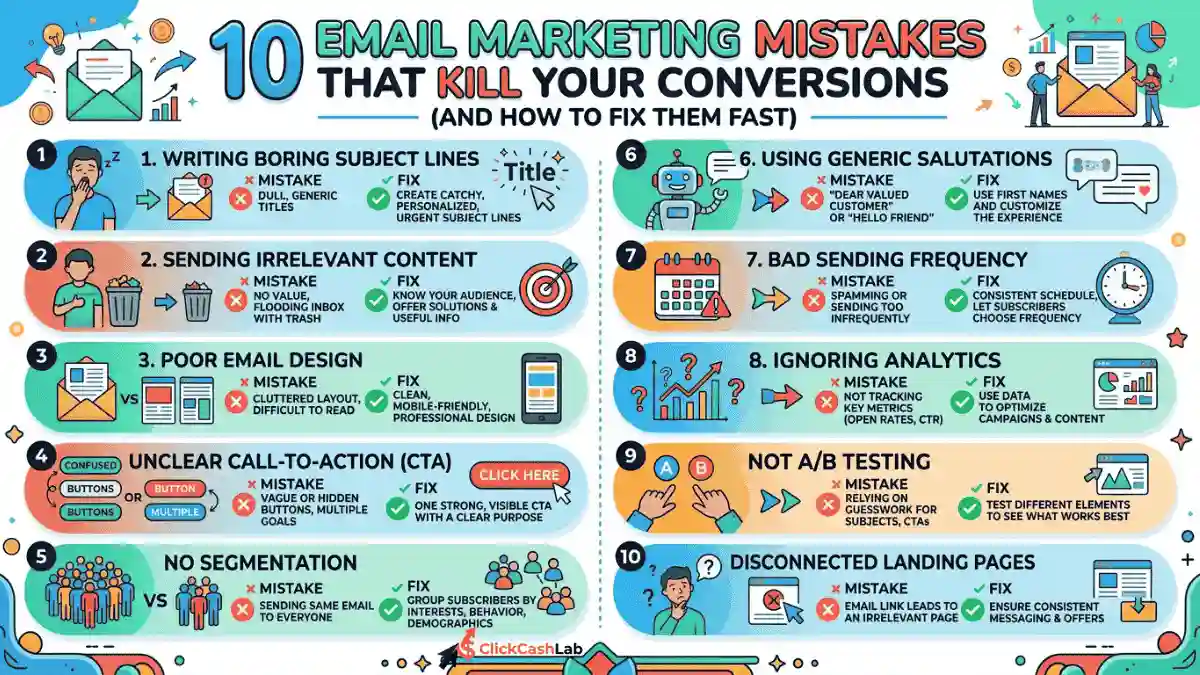
Fix Them Fast: 10 Email Marketing Mistakes Kill Your Conversions: Email marketing still sits at the heart of digital revenue generation, even in 2026, but it has become far more competitive and unforgiving. Every inbox is crowded, attention spans are shrinking, and users are far more selective about what they open and click. This means that even small mistakes in your email strategy can silently destroy your conversion rates without you realizing it. You might be sending thousands of emails and still wondering why sales are flat, and the answer often lies in hidden structural issues rather than obvious campaign failures.
The reality is that email marketing success is no longer about volume—it’s about precision, timing, and relevance. When your messaging misses even slightly, subscribers disengage quickly. Think of email marketing like fishing in a lake: if your bait is wrong or your timing is off, you won’t just catch fewer fish—you’ll scare them away entirely. That’s exactly what happens when conversion killers creep into your strategy unnoticed.
Another major issue is that marketers often focus only on surface-level metrics like open rates while ignoring deeper signals such as click-to-conversion ratio or unsubscribe velocity. These hidden indicators often reveal whether your strategy is healthy or slowly collapsing. Understanding these fundamentals is the first step toward fixing the mistakes that matter most.
Why email marketing still drives revenue in 2026
10 Email Marketing Mistakes Kill Your Conversions Fix Them Fast. Email marketing continues to outperform most digital channels because it offers direct access to your audience without algorithm interference. Unlike social media platforms, where visibility depends on unpredictable algorithms, email lands directly in a personal inbox. This gives brands a unique opportunity to build consistent relationships and drive repeat conversions over time. However, this advantage only works when the emails themselves are relevant, engaging, and properly optimized for user behavior.
Modern consumers expect personalization, speed, and value in every message they receive. If your email feels generic or irrelevant, it will be ignored or deleted instantly. That’s why high-performing brands treat email not as a broadcasting tool but as a conversation channel. The moment you stop thinking about your audience’s needs, your conversion rates begin to decline.
How small mistakes lead to big conversion drops

One of the most dangerous aspects of email marketing is how small mistakes compound over time. A slightly weak subject line might reduce your open rate by 10%, poor segmentation might reduce clicks by another 15%, and a confusing call-to-action might reduce conversions further. Individually, these issues seem minor, but together they can cut your revenue in half without obvious warning signs.
What makes this even more challenging is that email platforms often mask these problems with vanity metrics. You may still see “good” open rates while actual sales decline. This creates a false sense of security that delays optimization efforts. The longer these mistakes persist, the more your audience disengages, making recovery harder over time.
Key metrics that reveal hidden performance issues
To truly understand your email performance, you need to look beyond basic metrics. Open rates only tell you whether your subject line worked, not whether your content was effective. Click-through rates give more insight, but conversion rates reveal the real truth about campaign performance. If people are opening and clicking but not buying or signing up, your message alignment is broken. 10 Email Marketing Mistakes Kill Your Conversions Fix Them Fast
Another critical metric is unsubscribe rate. A sudden spike in unsubscribes often indicates content mismatch or over-emailing. Spam complaints are even more serious because they can damage your sender reputation long-term. Monitoring these indicators together gives you a clearer picture of whether your email strategy is healthy or slowly failing.

Mistake 1: Poor List Segmentation
Segmentation is one of the most powerful tools in email marketing, yet it is also one of the most commonly ignored. Many marketers treat their email list as a single audience, sending identical messages to everyone regardless of behavior, interests, or purchase history. This approach might seem efficient on the surface, but it dramatically reduces relevance—and relevance is the foundation of conversions. When people receive emails that don’t match their needs, they mentally disconnect from your brand, even if they don’t unsubscribe immediately.
Poor segmentation also leads to what can be described as “message fatigue.” Subscribers begin to feel like they are just another name in a database rather than valued individuals. Over time, this weakens engagement rates and reduces trust. Even highly compelling offers will fail if they are delivered to the wrong segment. That’s why segmentation isn’t just a marketing tactic—it’s a conversion necessity. 10 Email Marketing Mistakes Kill Your Conversions. Fix Them Fast.
Another hidden issue with poor segmentation is that it distorts your analytics. If your audience is too broad, your performance data becomes meaningless. You can’t accurately identify what works because different audience types respond in different ways. This makes optimization nearly impossible and leads to repeated mistakes in future campaigns.
Sending the same message to everyone
10 Email Marketing Mistakes Kill Your Conversions. Fix Them Fast. One-size-fits-all email campaigns are one of the fastest ways to reduce engagement. While it may seem convenient to send a single email to your entire list, it ignores the fundamental truth that subscribers are at different stages of the customer journey. Some are new leads, some are active buyers, and others may be inactive or disengaged. Treating them all the same guarantees that your message will be irrelevant to a large portion of your audience.
When emails lack relevance, people stop paying attention. They may still open your emails occasionally, but they won’t take meaningful action. This creates a dangerous illusion of engagement without real conversions. Over time, your sender reputation may also suffer as engagement rates drop across your entire list.
How segmentation improves engagement rates
Proper segmentation allows you to tailor your messaging based on behavior, demographics, or intent. For example, new subscribers might need educational content, while repeat customers respond better to loyalty offers. This level of personalization significantly increases engagement because the message feels more relevant and timely.
Segmented campaigns consistently outperform generic broadcasts in both open and click-through rates. More importantly, they improve conversion rates because they align with user intent. When subscribers feel understood, they are far more likely to take action. Segmentation essentially transforms email marketing from broadcasting into precision targeting.
Practical ways to segment your audience
There are several effective ways to segment your email list without overcomplicating your workflow. You can start with basic categories like new subscribers, active customers, and inactive users. From there, you can refine further based on purchase history, engagement level, or product interest. Even simple segmentation can dramatically improve performance.
Behavior-based segmentation is especially powerful because it reflects real user intent. For example, tracking which emails users click allows you to group them based on interest topics. This enables highly targeted follow-ups that feel natural rather than forced. Over time, this approach builds stronger relationships and significantly improves conversion rates.
Mistake 2: Weak or Misleading Subject Lines
Subject lines are the gatekeepers of your entire email strategy. No matter how strong your content is, it won’t matter if people never open the email. Weak or misleading subject lines are one of the most common reasons for low engagement, and they often go unnoticed because marketers assume their content is the problem. In reality, the issue starts much earlier—in the inbox preview.
A subject line is essentially a micro-pitch. You have only a few seconds to convince someone that your email is worth their attention. If it feels boring, generic, or unclear, it gets skipped immediately. On the other hand, if it feels overly exaggerated or misleading, it may get opened once—but trust will erode quickly, leading to long-term disengagement.
Why subject lines determine open rates
10 Email Marketing Mistakes Kill Your Conversions. Fix Them Fast. Subject lines directly influence whether your email gets opened or ignored. They act as the first impression of your message and often determine the success or failure of the entire campaign. Even minor wording changes can significantly impact open rates because inboxes are highly competitive environments.
People scan their inboxes quickly, often deciding within seconds which emails deserve attention. This means your subject line must immediately communicate value, curiosity, or urgency. Without this clarity, your email simply becomes invisible in a crowded inbox.
Clickbait vs. clarity balance
One of the biggest mistakes marketers make is leaning too heavily into clickbait tactics. While curiosity-driven subject lines can boost open rates temporarily, they often backfire if the email content doesn’t deliver on the promise. This creates a trust gap that reduces long-term engagement.
10 Email Marketing Mistakes Kill Your Conversions Fix Them Fast, The ideal subject line strikes a balance between curiosity and clarity. It should be interesting enough to stand out but honest enough to set proper expectations. When readers feel that your emails consistently deliver value, they become more likely to engage over time.
Proven formulas for high-performing subject lines
High-performing subject lines often follow simple but effective formulas. These include personalization, urgency, and value-driven statements. For example, adding the subscriber’s name or referencing their behavior can significantly increase open rates. Similarly, clear benefit-driven language tends to perform better than vague marketing phrases.
Another effective approach is using problem-solution framing, where the subject line highlights a pain point and hints at a resolution inside the email. This naturally encourages curiosity without resorting to manipulation. Over time, testing different formats helps identify what resonates most with your audience.
Mistake 3: Deliverability Issues That Send Emails to Spam
Email deliverability is one of those invisible forces in marketing that most people only think about when something goes wrong. You can have the best copy in the world, a perfectly segmented list, and irresistible offers—but if your emails land in spam or promotions tabs, your conversion strategy collapses before it even begins. Deliverability is essentially the bridge between your message and your audience, and when that bridge is weak, everything else becomes irrelevant. 10 Email Marketing Mistakes Kill Your Conversions. Fix Them Fast.
What makes deliverability particularly tricky is that it doesn’t fail loudly. Instead, it declines slowly over time. You might still see decent open rates at first, giving you a false sense of security. But behind the scenes, inbox providers like Gmail and Outlook are constantly evaluating your sender reputation. If engagement drops or suspicious patterns appear, your emails get filtered out more aggressively. That’s how many brands suddenly wake up to a sharp decline in revenue without realizing the root cause started months earlier.
Deliverability issues are often the result of multiple small mistakes rather than a single catastrophic error. Things like inconsistent sending patterns, poor list hygiene, or spam-triggering language can quietly damage your reputation. Once that trust is lost, rebuilding it takes time and careful optimization. That’s why understanding how inbox placement works is essential for long-term email marketing success.
Common triggers for spam filters
Spam filters are designed to protect users from irrelevant or harmful content, but they can also mistakenly flag legitimate marketing emails. Certain patterns increase the likelihood of this happening. Overuse of promotional language like “Buy now,” “Limited time offer,” or excessive punctuation can raise red flags. Similarly, sending emails with broken formatting or too many links can signal low-quality content. 10 Email Marketing Mistakes Kill Your Conversions. Fix Them Fast.
Another major trigger is poor list quality. If your list contains inactive or unverified emails, your bounce rate increases, which negatively affects your sender reputation. Even something as simple as inconsistent engagement—where many users ignore your emails over time—can push your messages into the spam folder. Understanding these triggers helps you avoid unintentional mistakes that harm deliverability.
Importance of sender reputation
Sender reputation is essentially your credibility score in the email ecosystem. Inbox providers evaluate how recipients interact with your emails to determine whether you are a trusted sender. High engagement rates improve your reputation, while low engagement or spam complaints damage it. 10 Email Marketing Mistakes Kill Your Conversions Fix Them Fast
Think of sender reputation like a credit score for email marketing. Once it drops, everything becomes harder—your emails don’t reach inboxes, your open rates decline, and your conversions suffer. The key to maintaining a strong reputation is consistency, relevance, and list hygiene. When subscribers consistently engage with your content, inbox providers reward you with better placement.
Steps to improve inbox placement
Improving inbox placement requires both technical and strategic adjustments. One of the first steps is cleaning your email list regularly to remove inactive or invalid addresses. This reduces bounce rates and improves engagement metrics. Another important step is warming up your sending domain if it is new or previously inactive.
You should also focus on sending relevant content that encourages interaction. Emails that receive clicks and replies signal positive engagement to inbox providers. Additionally, avoiding sudden spikes in email volume helps maintain stability in your sending patterns. Over time, these practices work together to strengthen deliverability and ensure your emails consistently reach the inbox instead of being filtered out.
Mistake 4: Bad Email Design and UX
10 Email Marketing Mistakes Kill Your Conversions Fix Them Fast, Email design is often underestimated in marketing strategy, yet it plays a crucial role in how users interact with your content. Even the most persuasive copy can lose its impact if the email is visually cluttered, hard to read, or not optimized for mobile devices. In today’s fast-paced digital environment, users make split-second decisions about whether to engage or delete an email, and design heavily influences that decision.
A poorly designed email creates friction. If readers struggle to find the main message or call-to-action, they lose interest quickly. On the other hand, clean and intuitive design guides the reader naturally through your content, making it easier for them to take action. This is why user experience (UX) in email marketing is just as important as the message itself.
Another major issue with bad email design is inconsistency. When your emails look different every time or don’t align with your brand identity, it creates confusion. Consistency builds familiarity, and familiarity builds trust. Without it, your emails may feel disconnected from your brand, reducing overall engagement and conversions.
Mobile-first design failures
More than half of all emails are opened on mobile devices, yet many marketers still design emails primarily for desktop. This leads to broken layouts, tiny fonts, and buttons that are difficult to tap. When users have to zoom in or scroll excessively, they are far more likely to abandon the email altogether.
Mobile-first design ensures that your emails are readable and actionable on any screen size. This means using responsive layouts, large clickable buttons, and concise text formatting. Ignoring mobile optimization is essentially ignoring the majority of your audience, which directly impacts conversion rates. 10 Email Marketing Mistakes Kill Your Conversions Fix Them Fast
Overloaded layouts that confuse readers
One of the most common design mistakes is overcrowding emails with too much information. When everything is emphasized, nothing stands out. Users don’t want to decipher complex layouts—they want clarity and direction. If your email includes multiple competing messages, readers often end up taking no action at all.
A clean layout with a clear hierarchy helps guide attention toward the most important elements. White space, simple formatting, and focused messaging all contribute to better readability. The goal is not to impress users with complexity but to guide them effortlessly toward conversion.
How simplicity improves conversions
Simplicity in email design is not about doing less—it’s about doing what matters most. Simple emails load faster, are easier to read, and reduce cognitive overload. When users don’t have to think too hard, they are more likely to act quickly.
Minimalist design also enhances clarity. A single strong call-to-action stands out more effectively than multiple competing buttons. By removing distractions and focusing on one primary goal per email, you significantly increase the likelihood of conversions. Simplicity turns confusion into action, which is exactly what effective email marketing aims to achieve.
Mistake 5: No A/B Testing or Optimization
One of the most overlooked reasons email campaigns underperform is the absence of systematic testing. Many marketers rely on intuition rather than data, assuming they know what their audience wants. While experience is valuable, it cannot replace real-world behavioral insights. Without A/B testing, you are essentially guessing—and in email marketing, guessing leads to inconsistent and often declining performance.
A/B testing is what separates average email marketers from high-performing ones. It allows you to compare different versions of subject lines, designs, calls-to-action, and even sending times to determine what actually works. Over time, these small experiments create significant performance improvements. Without them, your campaigns remain static while your audience’s behavior continues to evolve.
The biggest danger of not testing is stagnation. Even if your current strategy is performing reasonably well, it may slowly lose effectiveness as user preferences change. What worked six months ago might not work today, and without testing, you won’t notice the decline until it becomes significant.
Why guessing kills performance
Relying on assumptions instead of data is one of the fastest ways to reduce email effectiveness. Marketers often believe they know what their audience prefers, but user behavior frequently contradicts expectations. A subject line you think is strong might underperform, while a simpler version might outperform it dramatically.
Guessing also prevents growth. If you never test alternatives, you never discover better-performing strategies. This limits your potential and keeps your campaigns stuck at average performance levels. Data-driven decision-making eliminates uncertainty and replaces it with measurable improvement.
What to test in your email campaigns
There are several key elements you should consistently test in your email campaigns. Subject lines are one of the most impactful, as they directly affect open rates. Call-to-action buttons are another critical area, influencing click-through and conversion rates. Even small changes in wording, color, or placement can make a noticeable difference.
You can also test email length, design formats, personalization strategies, and sending times. Each of these factors contributes to overall performance, and testing them individually helps you understand what resonates most with your audience. The goal is continuous improvement rather than one-time optimization.
Turning data into consistent improvement
The real power of A/B testing lies in long-term optimization. A single test might show a small improvement, but repeated testing creates compounding gains over time. By consistently applying insights from your experiments, you gradually refine your entire email strategy.
This process turns email marketing into a dynamic system rather than a static one. Instead of relying on outdated assumptions, you continuously evolve based on real user behavior. Over time, this leads to stronger engagement, higher conversion rates, and more predictable revenue growth.
Conclusion
Email marketing success depends less on sending more emails and more on sending better ones. When segmentation is weak, subject lines are unclear, deliverability is ignored, design is cluttered, and testing is absent, even the most promising campaigns fail to convert. These mistakes often work silently in the background, slowly eroding performance without obvious warning signs.
Fixing them doesn’t require complexity—it requires awareness and consistency. Improving how you segment your audience, refining how your emails appear in inboxes, simplifying design, and embracing data-driven testing can transform your results over time. Email marketing becomes significantly more powerful when every part of the system works together instead of against itself.
FAQs
1. What is the biggest email marketing mistake that affects conversions?
10 Email Marketing Mistakes Kill Your Conversions Fix Them Fast, Poor segmentation is often the most damaging because it sends irrelevant messages to the wrong audience, reducing engagement and conversions across the board.
2. How important are subject lines in email marketing?
Subject lines are critical because they determine whether your email gets opened at all. Even strong content fails if the subject line doesn’t capture attention.
3. Why do emails go to spam even if they are legitimate?
Emails can be flagged due to poor sender reputation, spam-triggering words, low engagement rates, or poor list hygiene practices.
4. How does email design affect conversion rates?
Clean, mobile-friendly, and simple designs improve readability and guide users toward action, while cluttered layouts create confusion and reduce engagement.
5. How often should I A/B test my email campaigns?
A/B testing should be an ongoing process. Regular testing of subject lines, CTAs, and design elements ensures continuous optimization and improved performance over time.
What Is Email Marketing, Step-by-Step To Get 1,000 Subscribers for Beginners
