 Skip to content
Introduction
7 Automated Email Sequences That Generate Sales While You Sleep: Most people think email marketing is about sending newsletters and hoping someone clicks. But in 2026, that approach is outdated. The real power of email lies in automation—systems that run in the background, nurturing leads, building trust, and generating sales without you constantly being involved.
Imagine waking up and seeing sales notifications that came in while you were asleep. No manual sending. No last-minute campaigns. No-constant posting pressure. That’s not a fantasy anymore—it’s exactly what automated email sequences are designed to do.
Here’s the truth most beginners don’t realize: people rarely buy the first time they hear about you. They need reminders, explanations, reassurance, and timing. Automation handles all of that for you, step by step, in a structured way that feels personal—even though it runs on autopilot.
Instead of treating every subscriber the same, automated sequences guide people through a journey. Someone signs up? They get welcomed. Someone leaves items in their cart? They get reminded. Someone buys from you? They get upsold or nurtured for repeat purchases. Every action triggers a response, and every response moves them closer to a sale.
This is where email stops being just communication and becomes a revenue system.
In this guide, you’re going to discover 7 powerful automated email sequences that businesses use in 2026 to generate consistent sales. These aren’t theoretical ideas—they are real, tested systems that work quietly in the background while you focus on growing your business.
Because the goal isn’t just to send emails. The goal is to build a system that sells for you—even when you’re not there to press send.
Why Automated Email Sequences Are a Game-Changer in 2026

Automated email sequences have quietly become one of the most reliable ways to generate consistent online revenue in 2026. While most marketing trends come and go—especially on social media—automation has stayed relevant because it solves a simple but critical problem: timing. People don’t always buy when you want them to. They buy when they’re ready, and automated sequences make sure you’re present at every stage of that decision-making process.
What makes automation so powerful is that it removes the need for constant manual effort. Instead of sitting down every day to send emails or chase conversions, you build a system once and let it run continuously. It’s like setting up a digital salesperson that works 24/7, never gets tired, and never forgets to follow up. For small businesses, solo creators, and even large brands, this shift changes everything about how revenue is generated.
Another reason automation matters so much in 2026 is audience behavior. People are more distracted than ever, and attention spans are fragmented across platforms. Expecting someone to convert after a single interaction is unrealistic. Automated sequences solve this by staying present in a subscriber’s inbox over time, gradually building trust instead of forcing immediate decisions.
This is where email automation starts to feel less like marketing and more like relationship-building at scale. Each message has a purpose, whether it’s welcoming a new subscriber, educating them about a product, or nudging them toward a purchase they were already considering. The system adapts to behavior instead of relying on guesswork.
Perhaps the most underrated benefit is predictability. Once your sequences are optimized, you can forecast results more accurately. You know how many people enter your funnel, how they move through it, and how many convert. That level of clarity is rare in digital marketing, especially compared to volatile social media platforms. 7 Automated Email Sequences That Generate Sales While You Sleep
The Shift from Manual to Automated Marketing
Marketing used to be heavily manual. Every email had to be written, scheduled, and sent individually. Follow-ups depended on memory, and opportunities were often missed simply because someone forgot to send a message at the right time. That approach doesn’t scale, especially in a fast-moving digital environment.
The shift toward automation has fundamentally changed how businesses operate. Instead of thinking in terms of individual emails, marketers now think in systems and workflows. These systems are built once and triggered automatically based on user behavior. A new subscriber joins? They enter a welcome sequence. Someone clicks a product link but doesn’t buy? They enter a follow-up sequence. A customer completes a purchase? They move into an upsell or retention flow.
This shift is important because it reduces human error and increases consistency. Every subscriber gets the same structured experience, which improves both engagement and conversions. It also frees up time, allowing marketers to focus on strategy rather than repetitive tasks.
More importantly, automated marketing creates scalability. Whether you have 100 subscribers or 100,000, the system works the same way. You’re no longer limited by how fast you can manually send emails. Instead, your revenue potential grows with your audience automatically.
How Automation Creates Passive Revenue
One of the most attractive aspects of email automation is its ability to generate what many call “passive revenue.” While the term isn’t perfectly accurate—because systems still require setup and optimization—it does reflect the reality that once sequences are built, they continue producing results with minimal ongoing effort.
The key lies in evergreen workflows. These are email sequences triggered by user actions rather than specific dates or manual campaigns. For example, every new subscriber automatically enters a welcome series, every abandoned cart triggers a reminder sequence, and every purchase activates an upsell flow. These systems operate continuously in the background.
Because these sequences run 24/7, they can generate sales even when you’re not actively working. Someone might join your list at midnight, go through a sequence over the next few days, and make a purchase without you ever touching your dashboard. Multiply that by dozens or hundreds of subscribers, and you begin to see how automation scales revenue.
Another factor is compounding. As your email list grows, every new subscriber enters the same automated system. This means your revenue potential increases over time without requiring proportional increases in effort. Unlike manual campaigns, which reset after each send, automated sequences build momentum.
This doesn’t mean automation replaces strategy. The most successful systems are continuously refined based on performance data. But once optimized, they become one of the most efficient revenue engines in digital marketing. 7 Automated Email Sequences That Generate Sales While You Sleep
How Email Automation Actually Works

At first glance, email automation might sound technical or complicated, but the underlying concept is surprisingly simple. It’s based on three core elements: triggers, actions, and workflows. Once you understand how these pieces fit together, the entire system becomes much easier to visualize.
A trigger is what starts the sequence. This could be someone subscribing to your email list, clicking a link, abandoning a cart, or completing a purchase. The trigger is the “if this happens” part of the system.
An action is what the system does in response. This could be sending an email, waiting a set amount of time, or moving the subscriber into a different segment. Actions are the “then do this” part.
A workflow is the full sequence of triggers and actions combined. It’s the complete journey a subscriber goes through from start to finish. Think of it as a roadmap that guides people step by step toward a specific goal, usually a purchase or engagement milestone.
What makes this powerful is that once the workflow is set up, it runs automatically every time the trigger conditions are met. There’s no need for manual intervention. The system simply reacts based on predefined logic.
Triggers, Actions, and Workflows Explained Simply
To make this easier to understand, imagine a coffee shop loyalty system. When a customer signs up for a rewards program (trigger), they receive a welcome email with a discount (action). After a few days, they get another email encouraging them to try a featured drink (another action). Over time, they receive additional offers based on their behavior. That entire experience is a workflow. 7 Automated Email Sequences That Generate Sales While You Sleep
In email marketing, the same principle applies. A new subscriber might enter a 5-day welcome sequence. Day one introduces your brand, day two explains your value, day three shares a success story, and so on. Each step is automatically scheduled and sent based on timing rules.
More advanced systems can also include conditional logic. For example, if someone clicks a product link but doesn’t purchase, they might enter a different sequence than someone who ignores the email entirely. This level of personalization helps increase conversions because it responds to real behavior instead of assumptions.
Why Timing Matters More Than Frequency
One of the most overlooked aspects of email automation is timing. Many beginners focus on how many emails to send, but the real factor that drives results is when those emails are sent.
Timing determines relevance. A welcome email sent immediately after signup feels natural and expected. A follow-up email sent days later might serve as a reminder. A cart abandonment email sent within an hour can recover a lost sale. The closer the timing is to the action, the more effective the message tends to be.
This is why automation outperforms manual sending. Humans can’t consistently match behavioral timing at scale. Automation can. It ensures that every subscriber receives the right message at the right moment, without delay.
When timing, triggers, and workflows come together, email stops being a simple communication tool and becomes a structured revenue system that works continuously in the background.
The 7 Automated Email Sequences That Generate Sales
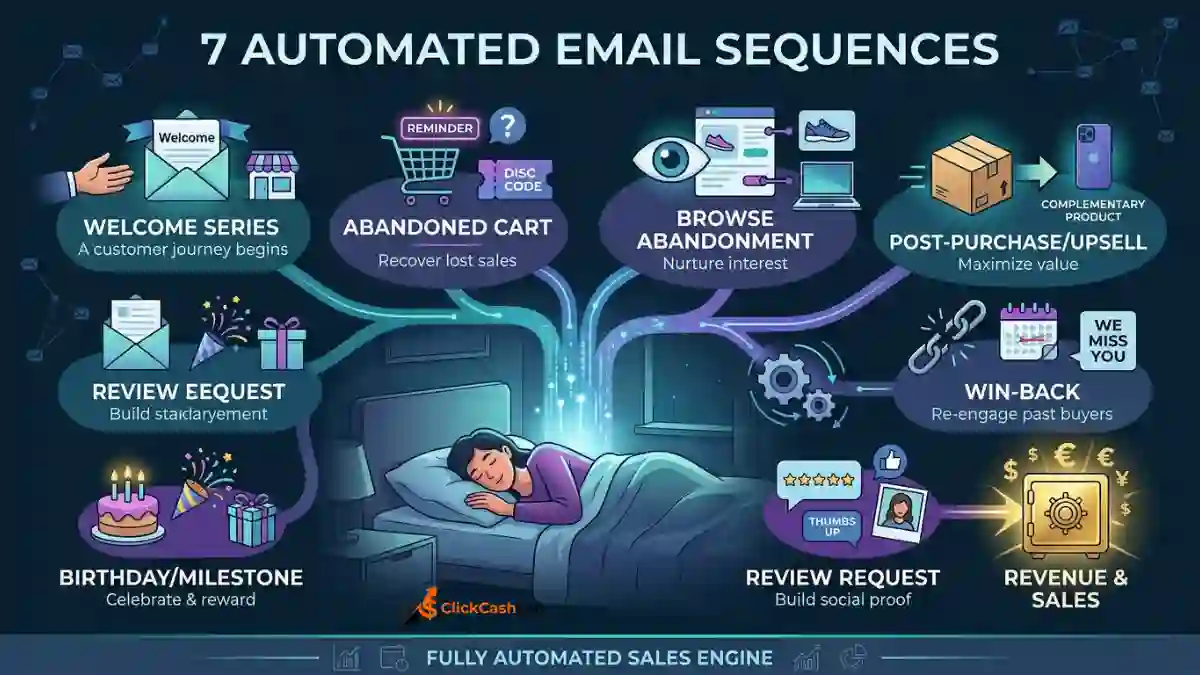
7 Automated Email Sequences That Generate Sales While You Sleep. Now that you understand how automation works and why timing matters, it’s time to look at the real engine behind consistent email revenue: the actual sequences. These are not random email blasts. They are structured, behavior-based systems designed to guide subscribers from curiosity to purchase with minimal friction.
Each sequence serves a specific purpose. Some are built to convert new subscribers, others to recover lost sales, and some to maximize customer lifetime value. When combined, they create a complete ecosystem that quietly generates revenue in the background.
Let’s break down the 7 most effective automated email sequences used in 2026.
1. Welcome Sequence
The welcome sequence is the foundation of your entire email marketing system. It is the first real interaction a subscriber has with your brand after joining your list, and it sets the tone for everything that follows. If done correctly, it can significantly increase long-term engagement and conversions.
This sequence typically begins immediately after someone subscribes. The first email usually delivers the promised lead magnet or confirmation, but more importantly, it introduces your brand in a simple, human way. Instead of overwhelming the reader, the goal is to build familiarity and trust.
Over the next few emails, you gradually guide the subscriber through your value proposition. You might share your story, explain what makes your offer different, or highlight common problems your audience faces. Each message builds context, making future offers feel more natural.
The real power of a welcome sequence lies in timing and momentum. New subscribers are at their highest level of interest right after signing up. If you engage them properly during this window, you significantly increase the chances of future sales.
A strong welcome sequence doesn’t sell aggressively—it prepares the buyer.
2. Abandoned Cart Sequence
The abandoned cart sequence is one of the highest revenue-generating automations in eCommerce and digital sales. It targets users who showed strong buying intent but didn’t complete the purchase.
When someone adds a product to their cart but leaves without buying, the system triggers a follow-up email sequence. The first email is usually a simple reminder. It brings the user back to what they left behind without pressure.
The second email often addresses hesitation. This could include benefits, testimonials, or answers to common objections. The goal is to remove friction and rebuild confidence in the decision.
A third email may introduce urgency, such as limited stock or time-sensitive offers. However, this must be used carefully to avoid sounding manipulative.
What makes this sequence powerful is timing. These emails are most effective when sent shortly after abandonment—while interest is still fresh. Even small improvements in recovery rates can lead to significant revenue increases.
3. Product Education Sequence
The product education sequence focuses on explaining value rather than pushing for immediate sales. This is especially important for complex or higher-priced products where customers need more information before making a decision.
Instead of jumping straight into promotion, this sequence breaks down how the product works, what problems it solves, and why it is useful. Each email focuses on a specific angle, making the product easier to understand over time.
For example, one email might explain the core benefit, another might show use cases, and another might address common objections. This layered approach helps reduce uncertainty, which is often the biggest barrier to purchase.
The goal here is not urgency—it’s clarity. When people fully understand a product, they are far more likely to buy it confidently.
4. Re-Engagement Sequence
Over time, some subscribers naturally become inactive. They stop opening emails, clicking links, or engaging with your content. Instead of letting these contacts go to waste, the re-engagement sequence attempts to bring them back.
This sequence typically starts with a simple message asking if they still want to hear from you. It’s low-pressure and direct. If there’s no response, follow-up emails may highlight what they’ve missed, such as updates, new content, or special offers.
Sometimes incentives are used, such as discounts or exclusive content, to encourage interaction. However, the key is not to spam but to reconnect.
Even if only a small percentage of inactive users re-engage, it can significantly improve list health and revenue performance over time.
5. Post-Purchase Upsell Sequence
Many businesses focus heavily on acquiring new customers but overlook one of the easiest ways to increase revenue: selling more to existing customers. The post-purchase upsell sequence is designed for exactly this purpose.
After a customer completes a purchase, they enter a sequence that introduces complementary products or upgrades. Because trust has already been established, these emails often perform better than initial sales campaigns.
The key is timing and relevance. The upsell should feel like a natural extension of the original purchase, not a random promotion. For example, someone who buys a beginner course might be offered an advanced version or bonus resources.
This sequence increases customer lifetime value without requiring additional acquisition costs, making it one of the most efficient revenue drivers.
6. Lead Magnet Nurture Sequence
The lead magnet nurture sequence is designed for subscribers who join your list through a free resource, such as an ebook, checklist, or guide. While these users may not be ready to buy immediately, they have already shown interest in your topic.
This sequence gradually builds trust by delivering additional value over time. Each email expands on the original lead magnet, offering deeper insights, tips, or case studies.
The goal is to transition subscribers from “free value seekers” to paying customers. This is done by subtly introducing your paid offers within valuable content rather than hard selling.
When executed well, this sequence turns cold leads into warm prospects over time.
7. Seasonal or Promotional Sequence
The seasonal or promotional sequence is triggered during specific events such as holidays, product launches, or limited-time offers. Unlike evergreen sequences, these are time-sensitive and designed to maximize short-term revenue.
These emails often rely on urgency, scarcity, and clear value propositions. For example, a Black Friday campaign might include a series of emails leading up to the event, during the sale, and just before it ends.
The key to success here is planning. The sequence should guide subscribers through anticipation, awareness, and action.
While not always evergreen, these sequences often produce some of the highest revenue spikes in email marketing.
How to Set Up These Sequences for Maximum Revenue
7 Automated Email Sequences That Generate Sales While You Sleep: Setting up email sequences is not just about writing emails and connecting triggers. The real difference between average and high-performing automation lies in strategy, structure, and optimization. When done correctly, these sequences don’t just send messages—they guide behavior in a predictable way that leads to consistent revenue.
The first step is understanding your customer journey. Before building anything, you need to map out how a subscriber moves from awareness to purchase. Each sequence should align with a specific stage in that journey. For example, new subscribers enter a welcome sequence, while returning visitors might enter a product-focused sequence. Without this structure, automation becomes random instead of intentional.
Next comes segmentation. Not every subscriber should receive the same messages. Dividing your audience based on behavior, interests, or purchase history allows you to deliver more relevant content. Relevance is what drives conversions. A well-segmented list will always outperform a generic one, even with the same number of subscribers.
Another critical factor is email spacing. Sending too many emails too quickly can overwhelm subscribers, while sending them too far apart can reduce momentum. The goal is to maintain engagement without causing fatigue. Most high-performing sequences use a balance of immediate follow-ups followed by spaced-out nurturing emails.
Finally, optimization is ongoing. No sequence is perfect from the start. Tracking open rates, click-through rates, and conversions helps identify weak points. Over time, small improvements compound into significant revenue gains.
Common Mistakes That Kill Automation Performance
7 Automated Email Sequences That Generate Sales While You Sleep. One of the most common mistakes in email automation is overcomplicating the system. Many beginners try to build overly complex workflows with too many branches, conditions, and variations. Instead of improving performance, this often creates confusion and reduces effectiveness. Simple, well-structured sequences usually outperform complicated ones.
Another major issue is focusing too much on selling too early. Subscribers who just joined your list are not always ready to buy immediately. If they are pushed into aggressive sales messages too soon, they may lose interest or unsubscribe. Building trust first is essential.
Ignoring segmentation is another frequent mistake. Treating all subscribers the same leads to irrelevant messaging, which reduces engagement. Even basic segmentation can significantly improve results.
Poor timing is also a silent killer of performance. Sending emails at random intervals instead of aligning them with user behavior reduces their impact. Automation works best when it feels natural and timely.
Lastly, many marketers fail to review performance data regularly. Without analyzing results, it’s impossible to know what’s working and what needs improvement. Automation is not a “set and forget forever” system—it requires ongoing refinement.
Tools That Make Email Automation Easy in 2026
Modern email marketing tools have made automation more accessible than ever. Platforms like Mailchimp, Brevo, MailerLite, and ConvertKit offer visual workflow builders that allow users to create sequences without technical knowledge.
These tools typically include drag-and-drop editors, pre-built automation templates, and behavior-based triggers. This means beginners can set up welcome emails, abandoned cart flows, and nurture sequences in a matter of hours rather than days.
Advanced platforms also offer analytics dashboards that track performance in real time. This makes it easier to identify which sequences are generating revenue and which need improvement.
Integration with eCommerce platforms, websites, and landing pages further enhances automation capabilities. Once connected, user actions automatically trigger email workflows, reducing manual effort completely.
The combination of simplicity and power is what makes modern email automation so effective. It allows even small businesses to build systems that operate at scale.
Conclusion
7 Automated Email Sequences That Generate Sales While You Sleep. Automated email sequences have transformed email marketing from a manual communication tool into a full-scale revenue system. Instead of relying on constant effort and manual campaigns, businesses can now build structured workflows that generate sales continuously in the background.
The seven sequences covered here—welcome, abandoned cart, product education, re-engagement, post-purchase upsell, lead magnet nurture, and seasonal promotions—form the backbone of any successful email automation strategy. When implemented correctly, they guide subscribers through a complete journey from awareness to purchase and beyond.
What makes this approach so powerful is its consistency. Once set up and optimized, these systems continue working without requiring daily intervention. They adapt to user behavior, respond to timing, and scale alongside your audience.
In 2026, the businesses that succeed with email marketing are not the ones sending the most emails—they are the ones building the smartest systems.
FAQs
1. What is an email automation sequence?
It is a series of pre-written emails triggered automatically based on user actions like signing up, purchasing, or abandoning a cart.
2. Do automated email sequences really make money?
Yes. When properly set up, they can generate consistent revenue by nurturing leads and recovering lost sales automatically.
3. How long should an email sequence be?
It depends on the goal, but most effective sequences range from 3 to 7 emails.
4. What is the most profitable email sequence?
The abandoned cart sequence and welcome sequence are often the highest-performing in terms of direct revenue impact.
5. Can beginners set up email automation easily?
Yes. Most modern email marketing tools offer simple drag-and-drop builders designed specifically for beginners.
How-to-Build an Email-List In 2026 From Scratch Without Paid Ads
Fix Them Fast: 10 Email Marketing Mistakes Kill Your Conversions
What Is Email Marketing for Beginners: Step-by-Step 1,000 Subscribers
(Tested & Ranked) Top Free Email Marketing Tools for Beginners
