 Skip to content
Introduction to Affiliate Email Marketing
Turn Subscribers Into Buyers. Email Marketing for Affiliate Beginners is one of the most powerful tools in affiliate marketing, especially for beginners who want to turn attention into predictable income. Instead of relying on social media algorithms or paid ads that constantly fluctuate, email gives you direct access to people who have already shown interest in what you offer. That simple shift—from chasing traffic to owning an audience—changes everything about how affiliate income is generated.
Affiliate email marketing is not about randomly sending product links and hoping for sales. It is about building a structured communication system where trust is established first, value is delivered consistently, and recommendations are introduced naturally. When done correctly, your email list becomes a warm audience that expects your suggestions rather than ignoring them.
What makes email particularly powerful for affiliates is timing. Most people do not buy immediately after discovering a product. They need reminders, explanations, comparisons, and reassurance. Email allows you to stay in their awareness throughout that decision-making process. Instead of losing potential buyers after one click, you can guide them step by step until they are ready to purchase.
Another key advantage is control. Platforms like Instagram, TikTok, or YouTube can change algorithms overnight, but your email list remains yours. This makes affiliate email marketing one of the most stable long-term income models in digital business. Even beginners can start small and gradually build a system that generates passive income over time.
This guide breaks down exactly how to turn subscribers into buyers using email marketing. From choosing the right affiliate products to writing persuasive emails and building automated sequences, you will learn how to create a system that consistently converts attention into commissions.
How Email Marketing Powers Affiliate Income
Email marketing powers affiliate income by creating a direct communication channel between you and potential buyers. Instead of relying on random traffic or unpredictable algorithms, you are building a controlled environment where every subscriber can be nurtured toward a purchase decision. This control is what makes email one of the highest-converting affiliate channels available today.
At the core of this system is trust. When someone joins your email list, they are giving you permission to communicate with them. This permission is extremely valuable because it allows you to build a relationship over time. Unlike cold traffic, email subscribers are already warmer leads, meaning they are more likely to engage with your recommendations.
Another important factor is repetition. Most affiliate sales do not happen from a single exposure. People often need multiple touchpoints before they feel confident enough to buy. Email allows you to follow up consistently without relying on external platforms. Each message reinforces your authority and keeps the product or solution top of mind.
Email also increases conversion rates by reducing friction. Instead of sending users directly to a sales page where they might get distracted or leave, you can pre-frame the offer inside your emails. This means explaining benefits, addressing objections, and sharing insights before they even click the affiliate link. By the time they reach the product page, they are already pre-sold.
The scalability of email marketing also plays a major role in affiliate income. Once you build automated sequences, your system can generate commissions even while you sleep. New subscribers are automatically guided through a structured journey that introduces affiliate offers at the right time.
Ultimately, Turn Subscribers Into Buyers. Email Marketing for Affiliate Beginners works because it combines psychology, timing, and direct communication. It transforms random visitors into engaged prospects and then into paying customers through consistent, value-driven messaging.
Understanding the Affiliate Funnel System
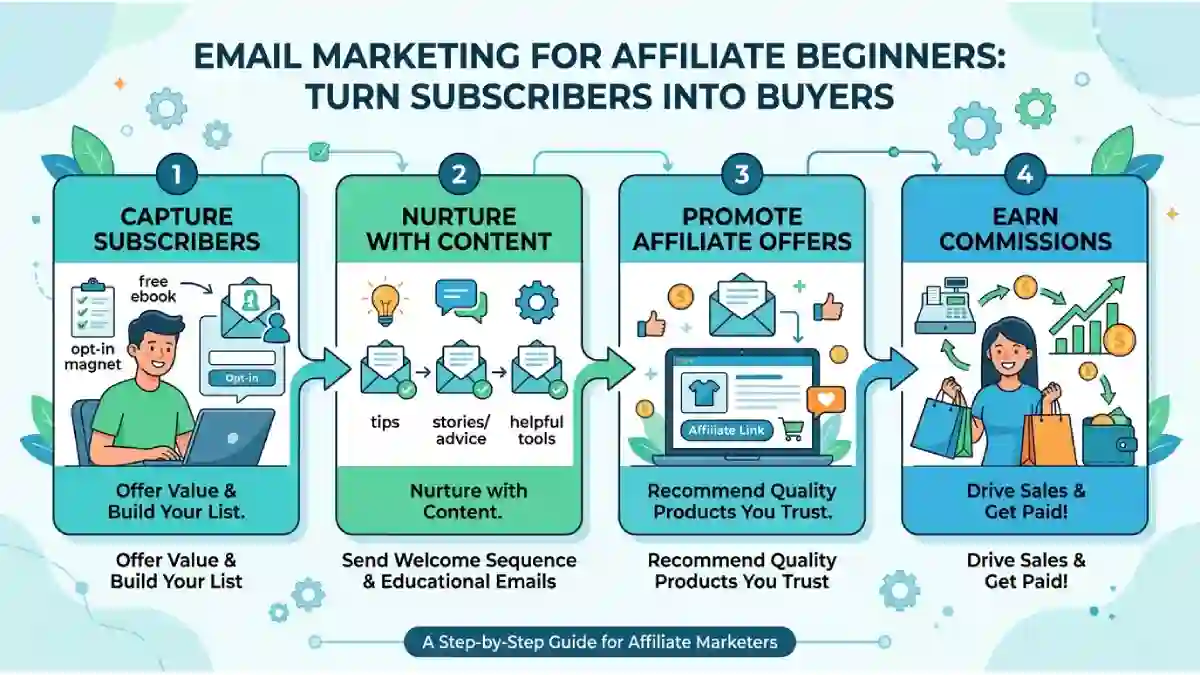
The affiliate funnel is the backbone of successful email marketing. It is the structured journey that takes a subscriber from curiosity to purchase. Without a funnel, affiliate emails become random and inconsistent, which leads to low conversions. With a funnel, every message has a purpose and moves the subscriber closer to a buying decision.
The funnel usually begins with a lead magnet. This is a free resource that attracts the right audience and gets them to join your email list. The key here is alignment—your lead magnet should naturally connect to the affiliate products you plan to promote. For example, if you are promoting a productivity tool, your lead magnet might be a guide on “How to Save 10 Hours a Week Using Automation.”
Once a subscriber joins your list, they enter the welcome sequence. This is where trust is built. Instead of immediately selling, you introduce yourself, provide value, and set expectations. This stage is critical because it shapes how subscribers perceive your emails going forward.
Next comes the value-building phase. Here, you send helpful content emails that educate, solve problems, or share insights. These emails position you as a trusted source rather than a salesperson. The goal is to build authority so that when you eventually recommend a product, it feels natural.
The final stage is the promotion phase. This is where affiliate offers are introduced strategically. Instead of pushing aggressively, you frame the product as a solution to the problems you have already discussed. This alignment between problem and solution is what drives conversions.
A strong affiliate funnel is not random—it is intentional, structured, and psychologically aligned with how people make purchasing decisions. When each stage works together, your email list becomes a predictable income system rather than a scattered collection of messages. Email Marketing for Affiliate Beginners: Turn Subscribers Into Buyers

Choosing the Right Affiliate Products
Choosing the right affiliate products is one of the most important decisions in email marketing because it directly affects your conversion rates and long-term credibility. Not every product is suitable for email promotion, and selecting the wrong ones can damage trust or result in low engagement.
The first factor to consider is relevance. Your affiliate products must align closely with your niche and the expectations of your audience. If someone joins your list expecting productivity tips, promoting unrelated fitness supplements will feel disconnected and reduce trust. Relevance ensures that your recommendations feel like natural extensions of your content.
The second factor is product quality. Promoting low-quality or poorly reviewed products might generate short-term commissions, but it will hurt your long-term reputation. In email marketing, trust is your most valuable asset. Once it is broken, it is very difficult to rebuild.
Commission structure also matters. Some affiliate programs offer one-time payouts, while others provide recurring commissions. Recurring commissions are especially powerful in email marketing because they create long-term passive income from a single conversion. SaaS tools, subscription services, and membership platforms often fall into this category.
Another important consideration is demand. The best affiliate products solve real, urgent problems. If people are actively searching for solutions or already spending money in that category, your chances of conversion increase significantly. High-demand niches like health, money, relationships, and digital tools tend to perform well for this reason.
Finally, consider conversion readiness. Some products have strong sales pages, clear benefits, and proven conversion funnels, while others do not. A well-optimized product will convert better even with the same traffic.
Choosing the right affiliate products is not about guessing—it is about matching audience intent with proven offers that solve real problems effectively.
Building a High-Intent Email List
A high-intent email list is one of the most valuable assets in affiliate marketing. Unlike random subscribers who join out of curiosity, high-intent subscribers are actively interested in solving a specific problem. This makes them far more likely to engage with your emails and purchase affiliate products.
Building this type of list starts with targeting. Instead of attracting broad audiences, you focus on specific problems or outcomes. For example, instead of “make money online,” you might target “how to automate online income” or “how to build a side income using AI tools.” Narrow targeting attracts more qualified subscribers.
Your lead magnet plays a huge role here. It should act as a filter that attracts only people who are interested in your affiliate offers. If your lead magnet is too generic, your list will be filled with low-intent subscribers who are unlikely to buy anything. Specificity increases quality.
Traffic sources also matter. Platforms like YouTube Shorts, TikTok, and niche blogs tend to attract more intent-driven users compared to passive browsing platforms. People who actively search or engage with problem-solving content are more likely to convert later.
Another key strategy is expectation setting. When subscribers join your list, they should immediately understand what kind of value they will receive. This helps align their mindset with your future affiliate recommendations.
A high-intent list is not about size—it is about quality. Even a small list of engaged subscribers can generate more revenue than a large but uninterested audience. In affiliate email marketing, intent is what turns subscribers into buyers.
Creating a Lead Magnet That Pre-Sells Offers
A lead magnet in Turn Subscribers Into Buyers. Email Marketing for Affiliate Beginners is not just a freebie—it is a strategic pre-selling tool. Its purpose is to attract the right audience and gently introduce them to the problems your affiliate products solve. When done correctly, it warms up subscribers before they even enter your email sequence.
The most effective lead magnets are highly specific and outcome-focused. Instead of general guides, they promise clear results. For example, “How to Generate Your First $100 Using AI Tools in 7 Days” is more powerful than “Beginner’s Guide to Making Money Online.” Specific outcomes attract higher-quality leads.
Your lead magnet should also align directly with your affiliate offers. If you plan to promote email marketing tools, your lead magnet could teach how to build an email list or automate outreach. This creates a natural transition from free value to paid recommendation.
Best Lead Magnet Types for Affiliate Marketers
PDF guides are the most common because they are easy to create and consume. Checklists are also highly effective because they simplify complex processes into actionable steps. Templates, such as email scripts or funnel frameworks, are especially powerful because they save users time and effort.
Video-based lead magnets can increase perceived value and engagement, especially in competitive niches. Short training videos or walkthroughs feel more personal and authoritative. Another strong format is case studies, which show real-world results and build credibility quickly.
The key to a successful lead magnet is not complexity but clarity. It should solve one specific problem and naturally lead into your affiliate ecosystem. When your lead magnet pre-sells effectively, your entire email funnel becomes significantly more profitable.
Writing a High-Converting Welcome Email Sequence
The welcome email sequence is the most important part of your affiliate email system because it sets the tone for everything that follows. When someone first joins your list, their interest is at its peak, making this the best opportunity to build trust and guide them toward your affiliate offers.
The first email should deliver the promised lead magnet immediately and reinforce the value they just received. This builds trust instantly and reduces unsubscribe rates. It is also the perfect place to introduce yourself briefly and set expectations for future emails.
The second and third emails should focus on value-building. This means sharing insights, tips, or frameworks related to the subscriber’s problem. The goal is to position yourself as a helpful source of information rather than a salesperson. These emails help warm up the audience emotionally and intellectually.
Once trust is established, you can begin gently introducing affiliate products. However, this should feel like a natural extension of the value you have already provided. Instead of pushing a product directly, you explain how it solves a specific problem you previously discussed.
A strong welcome sequence often determines the long-term profitability of your list. If done correctly, it turns cold subscribers into engaged readers who are open to your recommendations. Email Marketing for Affiliate Beginners: Turn Subscribers Into Buyers
Content Emails vs Promotional Emails
In affiliate email marketing, balance is everything. Sending too many promotional emails can lead to unsubscribes, while sending only content emails limits your income potential. The most successful affiliate marketers understand how to blend both types effectively.
Content emails are designed to educate, entertain, or solve problems. They build trust and keep your audience engaged. These emails often include tips, insights, or personal experiences that help subscribers improve their situation without directly selling anything.
Promotional emails, on the other hand, are focused on driving affiliate sales. They introduce products, explain benefits, and encourage clicks. However, even promotional emails should include value elements such as explanations or comparisons to avoid feeling overly aggressive.
A healthy balance often involves sending multiple content emails before introducing a promotional one. This ensures that your audience remains engaged and receptive. When subscribers trust your content, they are more likely to consider your recommendations seriously.
The key is to make promotional emails feel like helpful suggestions rather than sales pitches. When content and promotion work together, your email system becomes both profitable and sustainable.
Psychological Triggers That Drive Affiliate Sales
Affiliate email marketing is heavily influenced by psychology. People do not buy purely based on logic—they buy based on emotion, trust, and perceived value. Understanding these triggers can significantly improve your conversion rates.
One powerful trigger is social proof. When people see that others are using or benefiting from a product, they are more likely to trust it. Mentioning results, testimonials, or case studies can increase credibility.
Scarcity is another strong trigger. Limited-time offers or bonuses create urgency, encouraging quicker decisions. However, scarcity must be used ethically and realistically.
Authority also plays a major role. When you position yourself as knowledgeable or experienced in a niche, subscribers are more likely to trust your recommendations. This is why consistent value-building is essential.
Reciprocity is equally important. When you provide free value consistently, people feel more inclined to return the favor by purchasing through your recommendations.
These psychological principles, when applied correctly, make your affiliate emails significantly more persuasive without feeling manipulative.
Conclusion
Email marketing for affiliate beginners is one of the most accessible and scalable ways to generate online income. It does not require a website, complex funnels, or large budgets to get started. Instead, it relies on clarity, consistency, and understanding how to guide subscribers through a structured journey from curiosity to purchase.
When you combine a targeted list, a strong lead magnet, effective email sequences, and ethical product recommendations, your email system becomes a reliable income engine. The key is not to focus on quick wins but to build trust and relationships over time. That is what turns subscribers into long-term buyers.
FAQs
1. How many subscribers do I need to start making affiliate sales?
Even 100–300 engaged subscribers can generate sales if your emails are targeted and relevant.
2. What is the best affiliate niche for email marketing?
Popular niches include make money online, health, fitness, productivity, and digital tools.
3. How often should I send affiliate emails?
A balanced mix of 2–4 value emails per week with occasional promotions works well.
4. Do I need a website for affiliate email marketing?
No, you can use landing pages from email tools and social media traffic sources instead.
5. Why are my affiliate emails not converting?
Common issues include poor targeting, weak lead magnets, lack of trust-building, or overly aggressive selling.
Proven Subject Line Formulas + How to Write Emails That Actually Get Opened
(Tested & Ranked) Top Free Email Marketing Tools for Beginners
How-to-Build an Email-List In 2026 From Scratch Without Paid Ads
Fix Them Fast: 10 Email Marketing Mistakes Kill Your Conversions
