 Skip to content
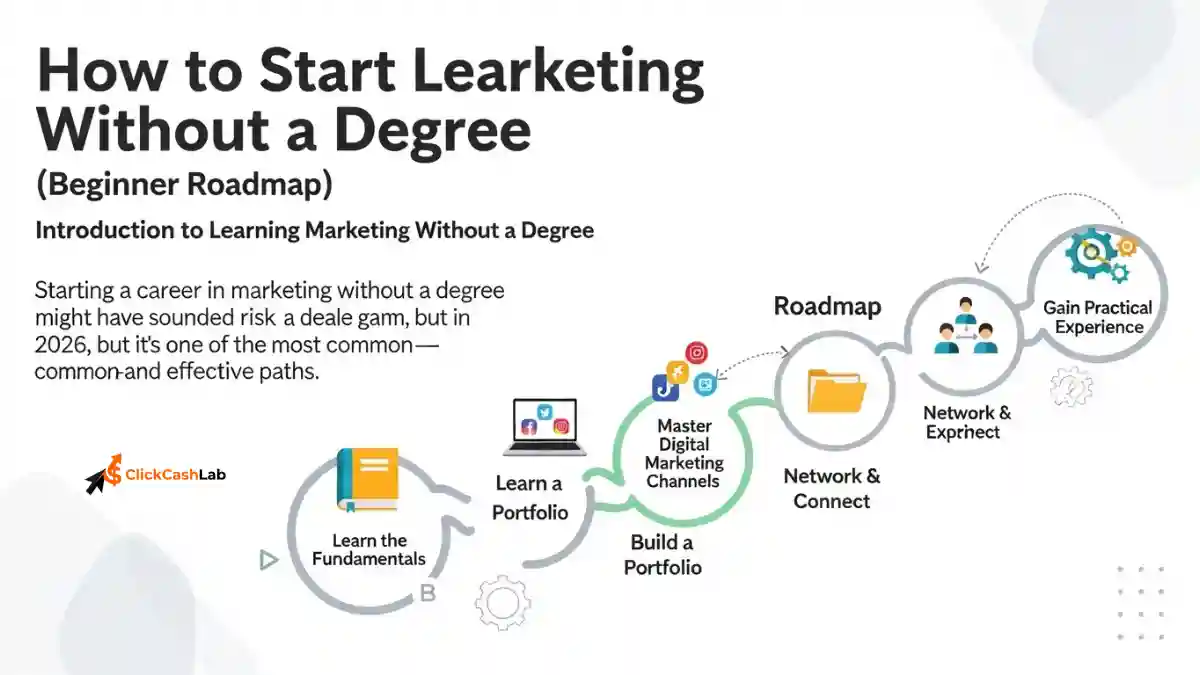
Introduction to Learning Marketing Without a Degree
Starting Learning Marketing Without a Degree might have sounded risky a decade ago, but in 2026, it’s one of the most common—and effective—paths. The digital world has changed the rules. Today, companies care far more about what you can do than where you studied. If you can drive traffic, create content, or generate leads, you already have value.
What makes marketing unique compared to many other fields is that it’s skill-based and results-driven. You don’t need a certification to prove you understand marketing—you can demonstrate it through real work. A blog that ranks on Google, a social media page that grows consistently, or a campaign that generates engagement speaks louder than any diploma.
Another reason why degrees are no longer essential is the explosion of free and accessible learning resources. From YouTube tutorials to hands-on platforms like Google Analytics and Meta Ads Manager, you can learn everything step by step without stepping into a classroom.
But here’s the catch: freedom comes with responsibility. Without a structured curriculum, it’s easy to feel lost. Many beginners jump between topics—SEO one day, social media the next—without building real depth. That’s why having a clear roadmap is crucial.
This guide is designed to give you exactly that—a step-by-step beginner roadmap to learn marketing from scratch, without a degree, and without wasting time on unnecessary information.
Why You Don’t Need a Degree in 2026

The idea that you need a degree to succeed in marketing is quickly becoming outdated. In fact, many of the most successful marketers today are self-taught. Why? Because the industry evolves too fast for traditional education to keep up.
Digital marketing platforms—like Google, TikTok, and Instagram—change their algorithms constantly. Strategies that worked last year might not work today. Universities, on the other hand, often take years to update their curriculum. This creates a gap between what is taught and what actually works in the real world.
Another major shift is how employers evaluate talent. Instead of asking, “Where did you study?” they now ask, “What have you done?”. A candidate who has managed a small blog, run ads, or grown a social media account often stands out more than someone with only theoretical knowledge.
There’s also the rise of the gig economy and freelancing. Many marketers no longer rely on traditional jobs. They build independent careers by offering services online. In this environment, results matter far more than credentials.
Let’s look at a simple comparison:
| Traditional Path | Self-Taught Path |
|---|---|
| Degree-focused learning | Skill-focused learning |
| Theory-heavy | Practice-heavy |
| Slow curriculum updates | Real-time learning |
| Expensive | Often free or low-cost |
The shift is clear. Marketing is no longer about formal education—it’s about practical ability and adaptability.
The Mindset Shift for Self-Taught Marketers

Learning Marketing Without a Degree: Before you learn tools or strategies, you need to adjust your mindset. This is where most beginners either succeed or fail.
The first mindset shift is moving from passive learning to active learning. Watching tutorials is helpful, but it’s not enough. Marketing is like learning to swim—you can’t do it by reading about it. You need to get into the water.
The second shift is embracing experimentation. Not everything you try will work—and that’s a good thing. Every failed post, campaign, or idea teaches you something valuable. In fact, failure is often the fastest way to learn.
Another important mindset is consistency over perfection. Beginners often wait for the “perfect moment” to start—a perfect idea, perfect content, or perfect strategy. But in marketing, progress comes from action, not perfection.
You also need to become comfortable with continuous learning. Marketing is not a one-time skill. It evolves constantly, and staying relevant means updating your knowledge regularly.
Finally, develop a problem-solving mindset. Marketing is not about tools or tactics—it’s about solving problems. If you can understand what people need and help them find solutions, you are already thinking like a marketer.
Step 1: Understand Marketing Fundamentals
Before diving into tools like SEO or social media ads, you need to understand what marketing actually is. Without this foundation, everything else becomes confusing and disconnected.
At its core, marketing is about connecting a product or service with the right audience. It’s not just about selling—it’s about communicating value in a way that resonates with people.
One of the most important concepts is the customer journey. This is the process people go through before making a decision:
- Awareness (they discover something)
- Consideration (they explore options)
- Decision (they take action)
Every marketing effort fits into one of these stages. Understanding this helps you create the right message at the right time.
Another key concept is target audience. Not everyone is your customer. Trying to appeal to everyone usually leads to weak messaging. The more specific you are about who you’re targeting, the more effective your marketing becomes.
You also need to understand value proposition—why someone should choose your product or content over others. This is what makes your marketing stand out.
Fundamentals may seem simple, but they are powerful. Once you understand them, every advanced strategy becomes easier to grasp.
What Marketing Really Means
Many beginners think marketing is just advertising or selling. In reality, it’s much broader than that.
Marketing is about understanding people—their needs, desires, and behaviors—and then communicating solutions in a way that feels relevant and valuable.
Think about it like this: good marketing doesn’t feel like marketing. It feels like helpful information, entertainment, or inspiration.
For example, a helpful blog post that answers a question is marketing. A TikTok video that educates or entertains is marketing. Even a well-written email is marketing.
This is why modern marketing focuses heavily on value-first content. Instead of pushing products, you attract people by offering something useful.
Another important aspect is trust. People don’t buy from brands they don’t trust. Marketing builds that trust over time through consistent, valuable communication.
Understanding this changes how you approach learning. Instead of chasing “quick hacks,” you focus on building real skills that create long-term impact.
Customer Psychology and Value Creation
At the heart of marketing lies psychology. Every click, purchase, or interaction is driven by human behavior.
People make decisions based on a mix of emotion and logic. Emotional triggers—like fear, excitement, or curiosity—often capture attention, while logic justifies the final decision.
For example, someone might feel excited about a product (emotion) and then check reviews before buying (logic).
As a beginner, you don’t need to master psychology, but you should understand basic principles:
- People look for solutions to problems
- People trust recommendations and social proof
- People prefer simplicity over complexity
Value creation is about aligning your content or product with these needs. If you can clearly show how you solve a problem or improve someone’s life, your marketing becomes naturally effective.
Think of marketing like a bridge. On one side is the customer’s problem, and on the other side is your solution. Your job is to connect the two in the clearest and most compelling way possible.
Step 2: Choose Your Core Skill Path
Once you understand the fundamentals of marketing, the next step is choosing a core skill path. This is where many beginners make a critical mistake—they try to learn everything at once. SEO, social media, ads, email marketing, analytics… it quickly becomes overwhelming. The result? Confusion, inconsistency, and burnout.
Here’s the reality: digital marketing is too broad to master all at once. Instead, you should start with one primary skill and build depth before expanding. Think of it like learning a sport—you don’t try to master every position on day one. You pick one role, get comfortable, and then grow from there.
Choosing a core path doesn’t mean limiting yourself forever. It simply gives you focus and direction in the early stages. Once you gain confidence in one area, you can layer additional skills on top of it.
The three most beginner-friendly entry points are:
- Content Creation & Copywriting (writing, blogs, videos)
- Search Engine Optimization (SEO) (organic traffic from Google)
- Social Media Marketing (growth on platforms like Instagram, TikTok, LinkedIn)
Each of these paths teaches slightly different skills, but they all connect. Content feeds SEO. SEO brings traffic. Social media amplifies reach. That’s why starting with one doesn’t isolate you—it actually builds a strong foundation.
The key is simple: depth first, breadth later.

Content, SEO, or Social Media?
Choosing between content, SEO, and social media depends on your strengths and preferences. There’s no “best” option—only what fits you best.
If you enjoy writing or explaining ideas, content creation is a great starting point. Blogging, newsletters, or even scriptwriting for videos can help you build communication skills quickly. This path naturally improves your ability to express ideas clearly and persuasively.
If you are more analytical and curious about how search engines work, SEO might be your ideal path. SEO teaches you how people search for information and how to position content so it gets discovered. It’s a slower process, but highly rewarding over time.
If you prefer fast-paced environments and visual content, social media marketing is a strong choice. Platforms like TikTok and Instagram allow you to experiment quickly and get immediate feedback. This makes learning faster and more interactive.
Here’s a simple comparison:
| Skill Path | Best For | Learning Style |
|---|---|---|
| Content Creation | Writers, educators | Deep, long-term |
| SEO | Analytical thinkers | Strategic, slow growth |
| Social Media | Creative, fast learners | Quick feedback |
No matter which path you choose, the goal is the same: build real skills through practice.
How to Avoid Learning Everything at Once
The biggest trap in self-Learning Marketing Without a Degree is information overload. With so many courses, videos, and tools available, it’s easy to feel like you need to learn everything immediately.
But trying to learn everything at once actually slows you down.
Instead, follow a focused learning approach:
- Pick one core skill (content, SEO, or social media)
- Spend 2–4 weeks learning the basics
- Apply what you learn through a small project
- Analyze results and improve
This cycle is far more effective than jumping between topics.
Another helpful technique is the 80/20 rule. Focus on the 20% of knowledge that delivers 80% of results. For example, in SEO, understanding keywords and content quality matters more than advanced technical details at the beginning.
You should also limit your learning sources. Instead of watching dozens of creators, follow a few reliable ones and go deep. Too many perspectives can create confusion instead of clarity.
Remember, progress in marketing is not about how much you know—it’s about how much you apply.
Step 3: Learn by Doing (Practical Learning)
This is where real learning begins. You can watch tutorials for weeks, but until you actually apply what you learn, your progress will be limited. Marketing is a performance skill, not a theoretical subject.
The fastest way to learn marketing is by doing real projects. These projects don’t need to be perfect or profitable—they just need to be real. They give you hands-on experience and help you understand how different elements work together.
Think of it like learning to ride a bike. You can study balance and movement, but you only learn when you actually ride.
Practical learning also builds confidence. The more you experiment, the more comfortable you become with tools, strategies, and decision-making.
Another benefit is feedback. Real-world projects give you data—views, clicks, engagement—that helps you understand what works and what doesn’t.
The key is simple: start before you feel ready.
Building Your First Marketing Project
Your first project is your training ground. It doesn’t need to be complex or perfect—it just needs to exist.
Here are a few beginner-friendly project ideas:
- Start a blog and write articles on a topic you enjoy
- Create a TikTok or Instagram page and post consistently
- Build a simple website and practice SEO
- Start a newsletter and share insights regularly
The goal of your first project is not success—it’s experience.
When building your project, focus on three things:
- Consistency – Show up regularly
- Clarity – Communicate ideas simply
- Learning – Improve with each attempt
Over time, your project becomes more than just practice—it becomes your portfolio.
Experimentation and Skill Growth
Experimentation is the secret weapon of self-taught marketers. It’s how you turn knowledge into skill.
Every piece of content you create is an experiment. Some will perform well, others won’t. Both outcomes are valuable.
For example, you might test:
- Different headlines or captions
- Posting times and formats
- Content styles (educational vs entertaining)
Over time, you start noticing patterns. These patterns become your strategy.
Another important concept is iteration. Instead of trying to create something perfect, you create something simple and improve it gradually. This approach leads to faster progress.
Experimentation also removes fear. When you treat everything as a test, failure becomes part of the process rather than something to avoid.
The more you experiment, the faster you grow.
Step 4: Master Essential Digital Tools
Tools are what turn your ideas into execution. They help you create content, analyze data, and automate processes.
However, beginners often make the mistake of focusing too much on tools instead of skills. Tools are important, but they are only as effective as the person using them.
Start with a small set of essential tools and learn them well.
Beginner-Friendly Marketing Tools
Here are some tools every beginner should explore:
| Tool | Purpose |
|---|---|
| Google Analytics | Track website traffic |
| Google Search Console | Monitor SEO performance |
| Canva | Create visual content |
| Notion / Docs | Plan and write content |
| Meta Business Suite | Manage social media |
These tools are enough to get started. You don’t need expensive software in the beginning.
The goal is not mastery—it’s familiarity. Learn what each tool does and how it fits into your workflow.
Automation and Productivity Basics
As you progress, you’ll notice that marketing involves many repetitive tasks. This is where automation becomes useful.
For example:
- Scheduling social media posts
- Automating email sequences
- Tracking performance reports
Automation saves time and allows you to focus on strategy and creativity.
But remember: automation should support your work, not replace thinking. Strategy always comes first.
Step 5: Build a Portfolio Without Experience
One of the biggest concerns beginners have is: “How do I get experience if no one hires me?”
The answer is simple: create your own experience.
Your projects—blog, social media page, or website—are your portfolio. They show what you can do, even without formal work experience.
Turning Practice into Proof
To turn your practice into proof, focus on results:
- Show growth (followers, traffic, engagement)
- Share before-and-after comparisons
- Document your process and learning
Even small results matter. They demonstrate initiative and capability.
You can also create case studies. For example, explain how you improved engagement on a page or optimized a blog for SEO.
Employers and clients care about results, not titles.
Step 6: Monetize Your Skills
Once you have basic skills and a portfolio, you can start monetizing your work.
This can include:
- Freelancing (content writing, social media management)
- Internships or entry-level roles
- Building your own brand or business
Start small. Even one client or small project is a big step forward.
Over time, your skills improve, your portfolio grows, and your opportunities expand.
Conclusion
Start Learning Marketing Without a Degree Today in 2026 is not only possible—it’s one of the most effective paths available. With the right roadmap, consistent practice, and a focus on real-world application, anyone can build valuable marketing skills from scratch.
The journey starts with fundamentals, grows through focused skill development, and accelerates through hands-on projects and experimentation. Each step builds confidence and capability.
Success in marketing doesn’t come from knowing everything—it comes from doing, learning, and improving consistently.
FAQs
1. Can I really learn marketing without a degree?
Yes, many successful marketers are self-taught. Skills and results matter more than formal education.
2. Which marketing skill should I learn first?
Start with content creation, SEO, or social media—whichever aligns with your interests.
3. How long does it take to learn marketing?
You can learn the basics in a few months, but mastery comes with continuous practice.
4. Do I need money to start learning marketing?
No, many tools and resources are free, making it accessible for beginners.
5. How do I get my first client or job?
Build a portfolio through personal projects and showcase your results to potential clients or employers.
Skills You Must Learn to Succeed in Online — Digital Marketing Education
How to Learn Digital Marketing Without a Degree & Self-Taught Marketing
What You Need to Learn First in 2026 – Marketing Education for Beginners
