 Skip to content
Introduction
Today Building an email list from scratch without paid ads, 2026 might feel like showing up to a race without a head start—but here’s the twist: the people who rely purely on speed often burn out, while those who build steadily tend to win in the long run. In 2026, when ad costs are rising and attention spans are shrinking, organic email list building has become one of the smartest and most sustainable strategies online.
At its core, an email list is your direct line to an audience that actually wants to hear from you. No algorithms deciding your reach. No platform suddenly limiting your visibility. Just you and your subscribers. That kind of control is rare in today’s digital landscape, and that’s exactly why it’s so valuable.
Now, let’s be real—You Can Build an Email-List In 2026 From Scratch Without Paid Ads isn’t instant. You won’t wake up tomorrow with 10,000 subscribers. But what you will build is something stronger: trust, consistency, and a loyal audience that actually engages with your content. And those are the kinds of subscribers who click, buy, and stick around.
This guide is designed to walk you through real, practical methods to grow your email list organically, even if you’re starting from zero. No shortcuts, no gimmicks—just strategies that work when you apply them consistently.
Why Email Lists Still Matter in 2026
With so many platforms competing for attention—TikTok, Instagram, YouTube, Threads—you might be wondering: is email still relevant? The answer is not just yes—it’s essential. In fact, many marketers consider email to be the highest ROI digital channel, with studies often citing returns of $36–$42 for every $1 spent.
The reason is simple: email is personal and direct. When someone subscribes to your list, they’re inviting you into a space that’s far more intimate than a social feed. Think about your own inbox—you don’t give your email to just anyone. That level of intent makes email subscribers incredibly valuable.
Another major advantage is stability. Social media platforms change constantly. One algorithm update can cut your reach dramatically overnight. But with email, you’re not dependent on a third-party platform to reach your audience. You own that connection.
There’s also the issue of distraction. Social media is noisy. Your content is competing with memes, ads, and endless scrolling. Email, on the other hand, offers a more focused environment. When someone opens your email, they’re choosing to engage with you specifically.
For creators, entrepreneurs, and businesses alike, email lists act as a foundation. You can launch products, share updates, promote content, or build relationships—all from a single channel that you control.
In a world where attention is fragmented, email remains one of the few places where you can truly connect.
The Power of Owned Audience

Easy Way to Build an Email-List In 2026 From Scratch Without Paid Ads, An owned audience is exactly what it sounds like—an audience you control, not one you borrow from a platform. This distinction is more important than it might seem at first glance.
When you build a following on social media, you’re essentially renting space. The platform decides who sees your content, when they see it, and how often. Even if you have thousands of followers, only a fraction may actually see your posts.
Today You Can Build an Email-List In 2026 From Scratch Without Paid Ads, With an email list, that dynamic changes completely. You have direct access to your audience. If you send an email, it lands in their inbox. There’s no algorithm filtering your reach.
This control translates into opportunity. Want to launch a product? You can promote it directly. Have a new piece of content? Share it instantly. Need feedback? Ask your subscribers. The relationship is more direct, more personal, and more reliable.
Owned audiences also tend to be more engaged. These are people who have taken an extra step to hear from you. They’re not just passive scrollers—they’re active participants.
Over time, this creates a compounding effect. A small, engaged email list can often outperform a large but passive social following. That’s why many successful online businesses prioritize email from day one.
Email vs Social Media: Control and Reach
Let’s put things into perspective with a simple comparison:
| Factor | Email Marketing | Social Media |
|---|---|---|
| Ownership | Full control | Platform-controlled |
| Reach | Direct to inbox | Algorithm-dependent |
| Engagement | Higher | Variable |
| Longevity | Evergreen | Short-lived |
Social media is great for discovery—it helps people find you. But email is where relationships deepen. It’s where casual followers turn into loyal supporters.
Another key difference is lifespan. A social media post might get attention for a few hours or days. An email, especially a well-written one, can sit in someone’s inbox and be revisited later.
The smartest strategy isn’t choosing one over the other—it’s using both together. Social media brings people in, and email keeps them connected.

Understanding the Basics of Email List Building
Before diving into tactics and strategies, it’s important to understand what you’re actually building. Many beginners jump straight into tools and templates without grasping the foundation, and that’s where things start to fall apart. Email list building isn’t just about collecting addresses—it’s about building a permission-based relationship with your audience.
At its simplest, email list building is the process of encouraging people to subscribe to your emails in exchange for value. That value could be content, insights, resources, or solutions to their problems. But here’s the key: people don’t give away their email addresses casually anymore. In 2026, inboxes are crowded, and attention is limited. If someone is willing to let you in, it means they expect something worthwhile in return.
This is why trust plays such a huge role. You’re not just asking for an email—you’re asking for access to someone’s personal digital space. If your messaging feels vague, generic, or overly promotional, people will hesitate. On the other hand, if you clearly communicate what they’ll gain, your chances of converting visitors into subscribers increase dramatically.
Another important concept is consistency. Building an email list is not a one-time effort—it’s an ongoing process. You’re constantly attracting new people, nurturing existing subscribers, and refining your approach based on what works.
Think of your email list like a community rather than a database. Each subscriber is a real person with specific interests, challenges, and goals. The better you understand them, the easier it becomes to create content they actually care about.
Once you understand this foundation, everything else—lead magnets, landing pages, traffic strategies—starts to make much more sense.
What Is an Email List?
An email list is essentially a collection of email addresses from individuals who have chosen to hear from you. But that definition barely scratches the surface. A high-quality email list is not just about numbers—it’s about relevance, engagement, and intent.
Imagine having 10,000 random email addresses versus 1,000 subscribers who genuinely care about your content. Which one do you think is more valuable? In most cases, the smaller, more engaged list wins every time. That’s because engagement drives results—opens, clicks, and conversions.
Email lists are typically built through opt-in forms, where users voluntarily provide their email in exchange for something valuable. This could be a free resource, access to exclusive content, or regular updates. This process ensures that your audience is interested from the start, which makes your marketing efforts far more effective.
There are also different types of email lists. Some are content-driven, where subscribers expect regular tips, articles, or updates. Others are more sales-focused, centered around promotions and offers. The best lists often combine both—providing value while occasionally introducing products or services.
Another important aspect is segmentation. As your list grows, not all subscribers will have the same interests. Segmenting your list allows you to send more targeted emails, which can significantly improve engagement and conversion rates.
At its core, an email list is an asset. Unlike social media followers, it’s something you own and control. And when built correctly, it becomes one of the most powerful tools in your online strategy.
How Email Marketing Works
You Can Build an Email-List In 2026 From Scratch Without Paid Ads, Email marketing might seem simple—send emails, get results—but there’s actually a structured system behind it. Understanding how it works can help you build a more effective strategy from the start.
The process usually begins with capturing leads. This is where your landing pages, lead magnets, and opt-in forms come into play. Once someone subscribes, they enter your email system, often managed by platforms like Mailchimp, ConvertKit, or Beehiiv.
Next comes the welcome sequence. This is a series of automated emails sent to new subscribers to introduce them to your content, build trust, and set expectations. Think of it as your first impression—it can make or break your relationship with your audience.
After that, you move into regular communication. This could be weekly newsletters, updates, or promotional emails. The goal here is to stay consistent without overwhelming your subscribers. Too many emails can lead to unsubscribes, while too few can cause people to forget about you.
Here’s a simplified flow:
- Attract visitors
- Convert them into subscribers
- Build trust through consistent emails
- Offer value and occasional promotions
- Generate engagement and revenue
What makes email marketing powerful is its measurability. You can track open rates, click-through rates, and conversions, giving you clear insights into what’s working and what’s not.
The key is balance. Focus too much on selling, and you lose trust. Focus only on content, and you miss monetization opportunities. The sweet spot is delivering value while naturally integrating offers.
Once you understand this flow, building and growing your email list becomes much more strategic—and much more effective.
Choosing the Right Niche and Audience
One of the most overlooked steps in building an email list is choosing who you’re actually building it for. It might seem tempting to create content for everyone, hoping to attract as many subscribers as possible. But in reality, that approach usually backfires. When your message is too broad, it becomes diluted—and people don’t feel like it’s meant for them.
Instead, successful email lists are built around specific niches and clearly defined audiences. Think of it like this: it’s much easier to attract 1,000 people who deeply care about a focused topic than 10,000 people who are only mildly interested in something generic.
Your niche doesn’t have to be ultra-narrow, but it should be clear enough that someone can immediately understand what you’re about. For example, “fitness” is broad, but “home workouts for busy professionals” is specific and relatable. That clarity makes it easier for people to decide, “Yes, this is for me.”
Another reason niche matters is content creation. When you know exactly who you’re speaking to, coming up with ideas becomes easier. You’re not guessing—you’re solving real problems for a specific group of people.
There’s also less competition when you go specific. Instead of competing with massive creators in a broad space, you carve out your own corner where your voice stands out.
Choosing the right niche is less about chasing trends and more about finding a balance between what people need and what you can consistently deliver. Once you get that right, everything else—lead magnets, content, emails—becomes more effective.
Identifying a Target Audience
Once you’ve chosen a niche, the next step is narrowing it down further into a target audience. This is where things start to get practical. Instead of thinking in general terms, you’re now focusing on real people with specific needs, goals, and challenges.
Ask yourself: who is most likely to benefit from what you offer? Are they beginners or experienced? Are they trying to learn something new, solve a problem, or improve a skill?
For example, if your niche is digital marketing, your audience could be small business owners, freelancers, or complete beginners. Each of these groups has different needs. A beginner might want simple step-by-step guides, while a business owner might be looking for advanced strategies.
The more clearly you define your audience, the easier it becomes to create content that resonates. Instead of generic advice, you can speak directly to their situation. That kind of specificity builds trust quickly.
Here’s a simple way to think about it:
- What problem does your audience have?
- What outcome do they want?
- What’s stopping them from getting there?
Answering these questions gives you a strong foundation for your content and lead magnets.
Another important factor is language. The way you communicate should match your audience’s level of understanding. Talking to beginners? Keep it simple. Speaking to experts? Go deeper.
When people feel like you “get” them, they’re much more likely to subscribe—and stick around.
Creating Audience Personas
If identifying your audience is about clarity, creating personas is about depth. An audience persona is a detailed profile of your ideal subscriber. It goes beyond basic demographics and dives into behaviors, motivations, and pain points.
Think of it as turning your audience into a real person. Give them a name, a background, and a story. For example:
“Sarah is a 32-year-old freelance designer who wants to grow her income but struggles with finding consistent clients. She spends time on Instagram and YouTube, looking for marketing tips but feels overwhelmed by conflicting advice.”
Now, instead of creating content for a vague group, you’re creating it for Sarah. This makes your messaging more focused and relatable.
Personas also help with decision-making. Not sure what lead magnet to create? Ask yourself: would Sarah find this useful? If the answer is yes, you’re on the right track.
You don’t need dozens of personas—one or two well-defined profiles are enough to start. As your list grows, you can refine and expand them based on real data and feedback.
Creating personas might feel like extra work at first, but it pays off in every aspect of your strategy. From content creation to email writing, everything becomes more intentional—and more effective.
Creating a High-Converting Lead Magnet
If your email list is the engine, then your lead magnet is the fuel that gets it moving. Without a compelling reason to subscribe, most people will simply leave and never come back. In 2026, attention is scarce, and inboxes are crowded—so your lead magnet needs to stand out instantly.
A lead magnet is something valuable you offer for free in exchange for someone’s email address. But here’s where many people go wrong: they create something they think is useful instead of something their audience actually wants. The difference might seem small, but it has a huge impact on conversion rates.
A high-converting lead magnet does one thing really well—it solves a specific problem quickly. Not ten problems. Not a broad topic. Just one clear outcome. For example, instead of offering “A Complete Guide to Fitness,” you might offer “A 7-Day Home Workout Plan for Beginners.” The second option is more focused, easier to understand, and more appealing.
Another important factor is immediacy. People love quick wins. If your lead magnet can deliver a result within minutes or hours, it becomes much more attractive. Think checklists, templates, cheat sheets—resources that people can use right away.
Presentation also matters. Even if your content is great, a poorly designed or confusing lead magnet can reduce its perceived value. It doesn’t need to be overly complex, but it should look clean, professional, and easy to consume.
Ultimately, your lead magnet is your first impression. It sets the tone for your relationship with your audience. If it delivers value, people will trust you more. If it disappoints, they may never engage again.
Types of Lead Magnets That Work
Not all lead magnets perform equally. Some formats consistently convert better because they align with how people consume information today—quickly, conveniently, and with minimal effort.
One of the most effective types is checklists. These are simple, actionable, and easy to follow. For example, a “Blog Post Publishing Checklist” gives immediate value without overwhelming the reader.
Templates are another high-performing option. Whether it’s a resume template, email script, or social media calendar, templates save time—and people are always willing to exchange their email for that kind of convenience.
eBooks and guides still work, but only if they’re focused. Long, generic PDFs tend to get ignored. Short, targeted guides that solve a specific problem perform much better.
Free courses or email series are also powerful. Instead of delivering everything at once, you provide value over several days. This not only helps with engagement but also introduces subscribers to your content style.
Here’s a quick comparison:
| Lead Magnet Type | Best For | Conversion Potential |
|---|---|---|
| Checklists | Quick wins | High |
| Templates | Time-saving | Very High |
| eBooks | In-depth info | Medium |
| Email Courses | Engagement | High |
The key is matching the format to your audience’s needs. If your audience values speed, go with checklists or templates. If they want deeper learning, consider guides or courses.
How to Make Your Lead Magnet Irresistible
Creating a lead magnet is one thing—making it irresistible is another. The difference lies in how clearly and convincingly you present its value.
Start with your headline. This is the first thing people see, and it determines whether they’ll pay attention or scroll past. A strong headline focuses on benefits, not features. Instead of saying “Free Marketing Guide,” say “Get Your First 1,000 Subscribers Without Paid Ads.” See the difference? One is vague, the other is outcome-driven.
Next, focus on clarity. People should immediately understand what they’re getting and how it will help them. Confusion kills conversions. Keep your messaging simple and direct.
Another powerful essential element is specificity. The more specific your promise, the more credible it feels. “Improve your productivity” is generic. “Plan your entire week in 30 minutes with this template” is specific and compelling.
Social proof can also boost conversions. If you have testimonials, user numbers, or results, include them. Even a simple line like “Downloaded by 2,000+ creators” can make a difference.
Finally, reduce friction. Don’t ask for too much information—usually, a name and email are enough. The easier it is to sign up, the higher your conversion rate.
An irresistible lead magnet doesn’t just offer value—it communicates that value clearly, quickly, and convincingly.
Building Landing Pages That Convert
You can have the best lead magnet in the world, but if your landing page doesn’t communicate its value effectively, conversions will suffer. A landing page is where visitors decide whether to subscribe or leave—and that decision often happens within seconds. That’s why every element on the page needs to work together with one goal in mind: getting the visitor to take action.
Unlike a full website, a landing page is focused and distraction-free. There are no unnecessary links, no clutter—just a clear message and a clear call to action. Think of it like a sales pitch boiled down to its essentials. You’re not trying to say everything—you’re trying to say the right things.
One of the biggest mistakes beginners make is overcomplicating their landing pages. They add too much text, too many images, or too many options. This creates confusion, and confused visitors don’t convert. Simplicity wins almost every time.
Another important factor is alignment. Your landing page should match the expectations set by your content or link. If someone clicks on a post about “growing an email list,” your landing page should directly relate to that topic. Any mismatch can reduce trust and increase bounce rates.
Trust signals also play a crucial role. These can include testimonials, user counts, or even a simple privacy statement reassuring visitors that their email won’t be misused. Small details like these can significantly impact conversion rates.
Ultimately, a high-converting landing page is not about flashy design—it’s about clarity, focus, and relevance. When done right, it turns casual visitors into engaged subscribers.
Essential Elements of a Landing Page
A successful landing page isn’t случай—it’s built using a set of proven elements that guide visitors toward taking action. Each component plays a specific role in the conversion process.
First, you have the headline. This is the most important part of your page. It should immediately communicate the main benefit of your lead magnet. If your headline doesn’t grab attention, most visitors won’t read further.
Next is the subheadline, which adds more context and reinforces the value. Think of it as your second chance to convince the reader to stay.
Then comes the visual element—this could be an image of your lead magnet, a mockup, or even a short video. Visuals help people understand what they’re getting and make the offer feel more tangible.
The call-to-action (CTA) is where the conversion happens. This is usually a button with text like “Download Now” or “Get Instant Access.” The wording should be clear and action-oriented.
Here’s a simple structure:
- Headline (clear benefit)
- Subheadline (supporting detail)
- Visual (preview of the offer)
- CTA (action step)
You may also include bullet points to highlight key benefits, but keep them concise. Avoid overwhelming the reader with too much information.
Finally, don’t forget mobile optimization. A large portion of users will view your page on their phones. If your page isn’t mobile-friendly, you’re likely losing potential subscribers.
When all these elements work together, your landing page becomes a powerful conversion tool rather than just another webpage.
Tools to Create Landing Pages for Free
The good news is you don’t need to be a developer—or spend money—to create effective landing pages. There are plenty of tools available that make the process simple, even for beginners.
Carrd is one of the most popular options. It’s lightweight, easy to use, and perfect for creating simple one-page websites and landing pages. Many creators use it as their starting point because of its simplicity.
Mailchimp and ConvertKit also offer built-in landing page builders. These tools are especially useful because they integrate directly with your email list, making the setup process seamless.
Notion + Super (or similar tools) have also gained popularity. While Notion itself isn’t a traditional landing page builder, it can be transformed into a clean, minimal landing page with the right setup.
Here’s a quick comparison:
| Tool | Best For | Ease of Use | Cost |
|---|---|---|---|
| Carrd | Simple pages | Very Easy | Free/Paid |
| Mailchimp | Email integration | Easy | Free plan |
| ConvertKit | Creators | Easy | Free plan |
| Notion + Super | Minimal setups | Medium | Free/Paid |
The key isn’t which tool you choose—it’s how you use it. A simple, clear landing page on a basic tool will always outperform a complicated page built with advanced software.
Start simple, test what works, and improve over time. That’s how you build landing pages that actually convert.
Driving Organic Traffic Without Ads
In 2026 From Scratch Without Paid Ads: Easy Way to Build an Email List Without Paid Adsbut comes down to one core skill: getting people to find you organically. No traffic means no subscribers—it’s that simple. But the good news is, organic traffic is not only free, it’s also often higher quality because people are actively searching for what you offer rather than being interrupted by ads.
Think of organic traffic like planting seeds across different platforms. Some grow quickly, others take time, but once they start producing, they can bring in a steady stream of visitors without ongoing costs. The key is choosing the right channels and being consistent.
One important mindset shift is understanding that organic growth is cumulative. Your first blog post might get 10 views. Your tenth might get 100. Your hundredth could get thousands. Each piece of content adds to your overall visibility, creating a compounding effect over time.
Another crucial factor is intent. People coming from search engines or educational content are often more motivated. They’re looking for answers, which makes them more likely to subscribe if you provide value.
You don’t need to be everywhere. It’s better to focus on one or two platforms and do them well rather than spreading yourself too thin. Whether it’s SEO, social media, or video content, consistency beats intensity.
Organic traffic isn’t instant, but it’s sustainable. And when combined with a strong lead magnet and landing page, it becomes one of the most powerful ways to grow your email list without spending a dime.
SEO Strategies for Beginners
Search Engine Optimization (SEO) is one of the most reliable ways to generate consistent, long-term traffic. It’s all about creating content that ranks on search engines like Google, so people can find you when they’re looking for information.
At the beginner level, SEO doesn’t have to be complicated. It starts with understanding what your audience is searching for. These are your keywords. Tools like Google autocomplete, AnswerThePublic, or even simple searches can give you insights into popular queries.
Once you have a keyword, the goal is to create content that answers that query better than anyone else. That doesn’t mean longer—it means clearer, more helpful, and more relevant.
Here are the core elements of beginner SEO:
- Use your main keyword in the title and headings
- Write clear, helpful content that solves a problem
- Structure your content for readability
- Include internal links if possible
Consistency is key. One optimized article won’t change much, but publishing regularly builds authority over time.
Another important concept is search intent. Are people looking for information, a solution, or a product? Matching your content to that intent increases your chances of ranking.
SEO takes time, but once your content ranks, it can bring in traffic for months or even years. That’s why many creators consider it one of the best long-term strategies for organic growth.
Using Social Media Organically
Social media is often associated with paid ads, but it’s also a powerful tool for organic growth—if used correctly. The key is to focus on engagement and value, not just posting for the sake of it.
Each platform has its own strengths. Instagram and TikTok are great for short-form, attention-grabbing content. Twitter (X) works well for insights and conversations. LinkedIn is ideal for professional and educational content. The trick is to choose a platform where your audience already spends time.
Organic growth on social media is driven by consistency and relevance. Posting regularly keeps you visible, while creating content that resonates increases engagement. And engagement is what pushes your content to more people.
One effective strategy is to create content loops. For example, a short video can lead to a longer YouTube video, which then directs viewers to your email list. Each piece of content supports the next.
Calls to action also matter. Don’t assume people will automatically subscribe—tell them why they should. A simple line like “Get the free checklist in my bio” can make a big difference.
Another tip is to engage with your audience. Reply to comments, ask questions, and participate in conversations. This not only builds relationships but also increases your visibility.
Social media might feel unpredictable at times, but when used strategically, it can become a steady source of traffic—and subscribers.
Leveraging Content Marketing
Content marketing is one of the most reliable long-term strategies for building an email list without paid ads. Instead of chasing people with ads, you’re attracting them naturally through valuable content. The idea is simple: create helpful, relevant, and consistent content that draws your ideal audience toward your lead magnet and email signup forms.
What makes content marketing powerful is its compounding nature. A single piece of content doesn’t just disappear after you publish it. If it’s optimized well, it can continue bringing traffic, subscribers, and engagement for months or even years. This is very different from paid ads, where the moment you stop paying, the traffic stops instantly.
Another important advantage is trust-building. When people discover you through content—whether it’s a blog post, video, or social media thread—they’re more likely to trust you compared to someone they see through an ad. That trust makes them far more willing to join your email list.
Content marketing also allows you to educate before you sell. Instead of directly asking for an email, you provide value first. Over time, this naturally leads people to want more from you, making them more likely to subscribe.
The key to success is consistency and alignment. Your content should always connect back to your niche and your lead magnet. Random content might get attention, but focused content builds an audience.
Blogging for Email Growth
Blogging remains one of the most effective tools for organic email list growth, even in 2026. Why? Because blogs are designed to be discovered through search engines. That means every blog post has the potential to bring in targeted, high-intent visitors who are already looking for answers.
The strategy is straightforward but powerful. You write blog posts around specific problems your audience is searching for, then naturally guide readers toward your lead magnet. For example, if someone is reading an article about “how to start freelancing,” you can offer a free checklist or guide related to getting first clients.
A well-structured blog post does three things:
- Provides clear and actionable value
- Builds trust with the reader
- Encourages email sign-ups through relevant offers
The placement of your opt-in forms matters a lot. You can include them within the content, at the end of posts, or as pop-ups (used carefully). The key is not to interrupt the reading experience but to enhance it with relevant offers.
Another important factor is keyword targeting. Writing blog posts based on what people are actively searching for ensures consistent traffic. Over time, as your content library grows, your blog becomes a powerful traffic engine that works 24/7.
Blogging requires patience, but once it gains momentum, it becomes one of the most stable sources of email subscribers.
YouTube and Short-Form Content Strategy
Video content has become one of the most dominant forms of online communication. Platforms like YouTube, TikTok, and Instagram Reels allow you to reach massive audiences without spending money on ads. And when done correctly, they can become powerful tools for building an email list.
YouTube is especially strong because it combines search and discovery. People actively look for tutorials, explanations, and solutions, which means your content can attract highly relevant viewers. Once you gain their attention, you can direct them to your email list through descriptions, pinned comments, or verbal calls to action.
Short-form content, on the other hand, is designed for reach. Platforms like TikTok and Reels prioritize engagement and virality. While these platforms may not convert directly as often as YouTube or blogs, they are excellent for driving awareness and funneling traffic.
A simple strategy is to use short-form content as the top of your funnel, and then guide viewers to longer content or lead magnets. For example:
Short video → YouTube video → Email signup page
This layered approach increases conversion opportunities at each stage.
The most important factor in video content is clarity. You have only a few seconds to capture attention, so your message needs to be direct and engaging. Once you have attention, your goal is to provide value quickly and guide viewers toward the next step.
Video content may take effort, but it offers one of the fastest paths to visibility and email list growth when used strategically.
Using Partnerships and Collaborations
One of the fastest ways to grow an email list without paid ads is to borrow attention that already exists. That’s exactly what partnerships and collaborations allow you to do. Instead of building an audience entirely from scratch, you connect with people who already have one—and find ways to exchange value.
This approach works because trust is transferable. When someone sees you recommended by a creator, blogger, or community they already trust, they’re far more likely to subscribe to your email list. In many cases, this can outperform months of solo content creation.
Collaborations don’t have to be complicated or formal. They can be as simple as guest posting on a blog, appearing on a podcast, co-creating content, or doing shoutout exchanges. The key is mutual benefit—both sides should gain something valuable.
The real advantage here is speed. While SEO and social media can take time to build momentum, collaborations can bring immediate bursts of targeted traffic. And when that traffic is paired with a strong lead magnet, conversion rates can be surprisingly high.
However, success depends on alignment. Partnering with the wrong audience—people who don’t match your niche—will bring traffic that doesn’t convert. So quality matters more than quantity.
When done consistently, collaborations can become a steady growth channel that complements your organic efforts.
Guest Posting and Cross-Promotion
Guest posting remains one of the most underrated yet powerful strategies for building an email list organically. The idea is simple: you write content for someone else’s platform, and in return, you get exposure to their audience. Within that content, you include a subtle and relevant call-to-action that leads readers to your email list.
The strength of guest posting lies in targeted exposure. You’re not reaching random people—you’re reaching an audience that already cares about your niche. That makes them far more likely to subscribe if your content resonates with them.
A successful guest post doesn’t feel like advertising. It feels like value. The better your content, the more trust you build, and the more likely readers are to check out your offer.
Cross-promotion works in a similar way but is often more direct. Two creators or businesses agree to promote each other’s content, newsletters, or lead magnets. This can happen through email shoutouts, social media posts, or content swaps.
Here’s a simple comparison:
| Strategy | Effort | Speed | Trust Impact |
|---|---|---|---|
| Guest Posting | Medium | Fast | High |
| Cross-Promotion | Low–Medium | Fast | Medium–High |
Both methods are effective because they leverage existing audiences instead of starting from zero. When combined with strong content and a clear lead magnet, they can significantly accelerate your list growth.
Leveraging Communities and Forums
Online communities are one of the most overlooked sources of free, high-quality traffic. Platforms like Reddit, Quora, Facebook Groups, Discord servers, and niche forums are filled with people actively asking questions, sharing problems, and looking for solutions.
The key to success in these spaces is participation, not promotion. Many beginners make the mistake of dropping links everywhere, which usually leads to being ignored or even banned. Instead, the focus should be on providing genuine value first.
When you consistently answer questions, share insights, and contribute meaningfully, people naturally become curious about you. That’s when they start checking your profile, content, or resources—and eventually your email list.
Communities work especially well because of intent. People are already in problem-solving mode. If your content or lead magnet fits their need, conversion rates can be very high.
Another effective approach is creating your own small community over time. This could be a group or forum where you engage directly with subscribers. While this takes longer to build, it strengthens loyalty and keeps your email list engaged beyond just emails.
The most important rule in communities is simple: be helpful first, promotional second. When you follow that consistently, communities become one of the most powerful organic traffic sources available.
Conclusion
Building an email list from scratch without paid ads is not about speed—it’s about strategy, patience, and consistency. In 2026, when attention is fragmented and advertising costs continue to rise, organic list building stands out as one of the most sustainable ways to grow an audience you truly own.
Every step in this process connects together. A clear niche helps you attract the right people. A strong lead magnet gives them a reason to subscribe. A well-designed landing page converts interest into action. And organic traffic sources like SEO, social media, content marketing, and collaborations bring people into your ecosystem.
What makes email powerful is not just the platform itself, but the relationship it enables. Unlike social media followers, email subscribers are people who have chosen to hear from you directly. That level of intent creates opportunities—whether you’re sharing content, building a brand, or promoting products.
There’s no shortcut to building a meaningful list, but there is a proven path. Start small, stay consistent, and focus on delivering value at every stage. Over time, those small efforts compound into something far more powerful than just numbers—they become a real, engaged audience that grows with you.
FAQs
1. How long does it take to build an email list without ads?
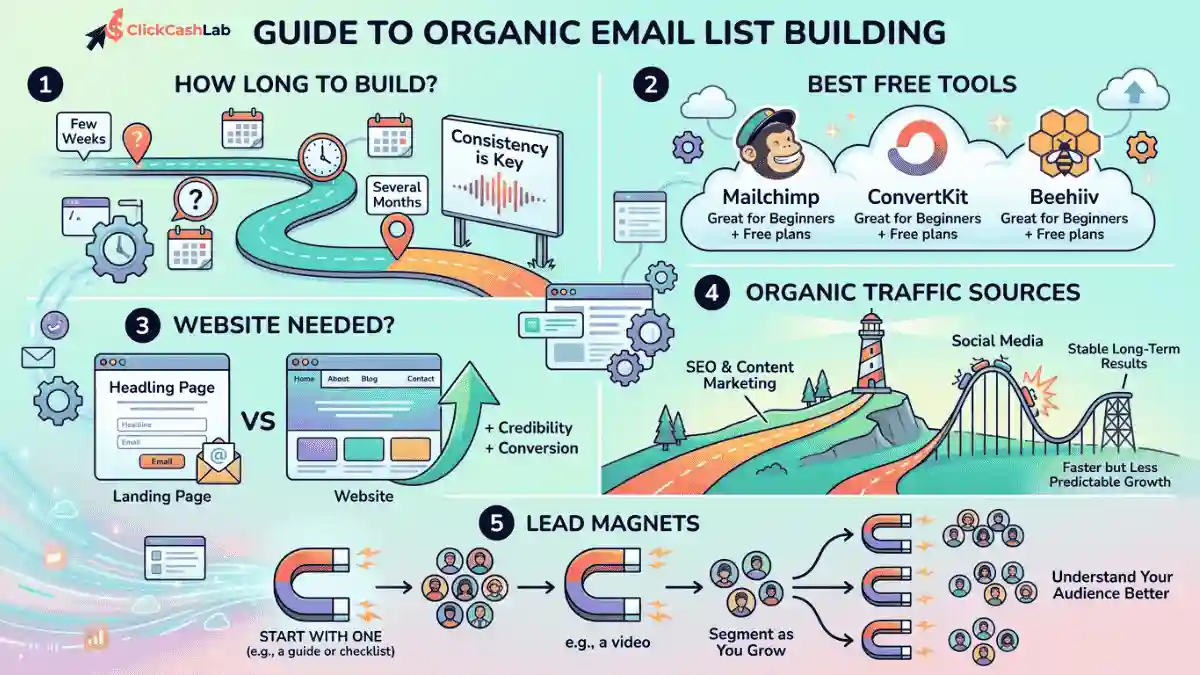
It depends on your consistency and traffic sources. Some people see results in a few weeks, while others take several months to build momentum.
2. What is the best free tool to start an email list?
Platforms like Mailchimp, ConvertKit, and Beehiiv offer free plans that are great for beginners.
3. Do I need a website to build an email list?
No, but having a website or landing page improves credibility and conversion rates significantly.
4. What is the most effective organic traffic source?
SEO and content marketing tend to provide the most stable long-term results, while social media offers faster but less predictable growth.
5. How many lead magnets should I create?
Start with one strong lead magnet. Once you understand your audience better, you can create additional ones for different segments.
What Is Email Marketing for Beginners: Step-by-Step 1,000 Subscribers
Fix Them Fast: 10 Email Marketing Mistakes Kill Your Conversions
