 Skip to content
Understanding Email Marketing Basics
What Is Email Marketing and Why It Matters
What Is Email Marketing for Beginners? Subscribers, Email marketing might sound old-school in a world obsessed with TikTok trends and algorithm hacks, but here’s the truth: it’s still one of the most powerful digital marketing tools available. Think of it as owning your own piece of the internet. Social media platforms can change rules overnight, but your email list? That’s yours. No algorithm decides whether your audience sees your message—you’re in direct control.
At its core, email marketing is the process of sending targeted messages to a group of people via email. These messages can range from newsletters and promotional offers to educational content and product updates. The goal isn’t just to sell—it’s to build relationships. And those relationships are what turn casual readers into loyal subscribers, and eventually, paying customers.
According to recent industry data, email marketing delivers an average ROI of $36 for every $1 spent, which is significantly higher than most other marketing channels. That’s not just impressive—it’s a wake-up call for beginners who are ignoring it. Why leave money on the table when a simple email strategy could start generating consistent results?
What makes email marketing especially beginner-friendly is its scalability. You don’t need thousands of subscribers to start seeing results. Even a list of 100 engaged people can outperform a social media account with 10,000 passive followers. Why? Because email is personal. It lands in someone’s inbox, not buried in a noisy feed.
If you’re just starting out, think of email marketing like planting seeds. Every subscriber is a seed. With the right care—valuable content, consistency, and trust—you’ll grow something that compounds over time. And the best part? You don’t need to be a tech genius to get started.
Key Benefits of Email Marketing for Beginners
When you’re new to digital marketing, it’s easy to get overwhelmed by choices. SEO, paid ads, content marketing, influencer partnerships—the list goes on. But email marketing stands out because it combines simplicity with power in a way few other channels can match.
First, let’s talk about control and ownership. Unlike social media platforms where your reach depends on ever-changing algorithms, your email list is something you fully own. No sudden bans, no unexpected reach drops. If you have 1,000 subscribers, you can reach all 1,000—simple as that. That kind of predictability is incredibly valuable when you’re trying to grow something from scratch.
Another major advantage is cost-effectiveness. Most email marketing platforms offer free plans for beginners, allowing you to build and nurture your list without spending a dime. Even as you scale, the cost per subscriber remains low compared to paid advertising. This makes it ideal if you’re working with a limited budget but still want meaningful results.
Then there’s personalization. Email allows you to speak directly to your audience in a way that feels intimate. You can segment your list based on interests, behavior, or demographics, and send tailored messages that resonate deeply. Imagine walking into a store where everything is curated just for you—that’s what good email marketing feels like.
Let’s not forget automation, which is where things get really exciting. Once you set up automated sequences—like a welcome series or a sales funnel—your emails can work for you 24/7. It’s like having a digital assistant who never sleeps, constantly engaging with your audience and moving them closer to your goals.
Finally, email marketing builds trust over time. People don’t buy from strangers—they buy from those they know and trust. By consistently delivering value in your emails, you position yourself as an authority in your niche. And when the time comes to make an offer, your audience is far more likely to say yes.
Setting Clear Goals Before You Start

Defining Your Target Audience
Before you even think about writing your first email or designing a signup form, you need to answer one critical question: Who are you talking to? Skipping this step is like trying to hit a target in the dark—you might get lucky, but chances are you’ll miss.
Your target audience is the specific group of people you want to attract and serve. These are the individuals who will find your content valuable, resonate with your message, and eventually become subscribers. But here’s where many beginners go wrong—they try to appeal to everyone. That’s a mistake. When you speak to everyone, you end up connecting with no one.
Instead, get specific. Think about demographics like age, gender, location, and profession. But don’t stop there—dig deeper into psychographics. What-are their goals? What problems are they trying to solve? What keeps them up at-night? The more you understand your audience, the easier it becomes to create emails that feel like they were written just for them.
One effective way to clarify your audience is by creating a customer persona. This is a semi-fictional representation of your ideal subscriber. Give them a name, a job, a lifestyle. For example, “Sarah, a 28-year-old freelance designer who wants to attract more clients but struggles with marketing.” Now, every time you write an email, you’re writing to Sarah—not a faceless crowd.
Understanding your audience also helps you choose the right tone and style. Are they professionals looking for in-depth insights? Or beginners who need simple, actionable advice? Your messaging should match their level of understanding and expectations.
When you get this right, everything else becomes easier. Your lead magnets will be more appealing, your emails more engaging, and your conversion rates higher. It’s like having a map before starting a journey—you know exactly where you’re going and how to get there.
Choosing the Right Email Marketing Goals
Once you know who you’re talking to, the next step is figuring out what you want to achieve. Without clear goals, your email marketing efforts can quickly become scattered and ineffective. You’ll send emails, sure—but will they actually move the needle? That’s the real question.
Start by identifying your primary objective. Are you trying to build brand awareness, generate leads, drive sales, or educate your audience? Each goal requires a slightly different approach. For example, if your goal is to build trust, your emails might focus on storytelling and valuable insights. If you’re aiming for sales, you’ll need stronger calls to action and persuasive copy.
It’s also important to set measurable goals. Instead of saying, “I want more subscribers,” define what that actually means. Do you want to reach your first 100 subscribers in a month? Your first 1,000 in six months? Having clear benchmarks helps you track progress and stay motivated.
Another key aspect is aligning your email goals with your broader business or personal objectives. If you’re a blogger, your goal might be to drive traffic to your latest posts. If you’re running an online store, it could be increasing repeat purchases. Your email strategy should support these larger goals, not exist in isolation.
Don’t forget about engagement metrics. Open rates, click-through rates, and unsubscribe rates all tell a story about how your audience is responding. Setting goals around these metrics can help you continuously improve your strategy. For instance, aiming for a 25% open rate gives you a clear target to work toward.
Think of your goals as a compass. They guide your decisions, keep you focused, and ensure that every email you send has a purpose. Without them, you’re just drifting. With them, you’re building a system that can reliably grow your audience and move you closer to that first 1,000 subscribers—and beyond.
Choosing the Right Email Marketing Platform

Popular Tools for Beginners
Picking your first email marketing platform can feel like standing in the cereal aisle—too many options, all promising to be the best. The truth? Most beginner-friendly tools do roughly the same thing, but the experience, pricing, and ease of use can vary wildly. What you need right now isn’t the most advanced platform—it’s the one that gets you sending emails quickly without friction.
Some of the most popular tools for beginners include Mailchimp, ConvertKit (now Kit), MailerLite, Brevo (formerly Sendinblue), and GetResponse. Each of these platforms offers a free or low-cost entry point, which is perfect when you’re building your first 1,000 subscribers and don’t want to overinvest upfront. Mailchimp is often the go-to for absolute beginners because of its intuitive interface, while ConvertKit shines for creators who want simple automation and clean design.
MailerLite deserves special attention because it balances simplicity with powerful features. You can build landing pages, create automation workflows, and design emails without feeling overwhelmed. Brevo, on the other hand, is great if you’re interested in combining email with SMS marketing down the line. It’s like choosing a starter car—you don’t need a Ferrari, you need something reliable that gets you moving.
Here’s a quick comparison to make things clearer:
| Platform | Best For | Free Plan | Ease of Use | Automation |
|---|---|---|---|---|
| Mailchimp | Absolute beginners | Yes | High | Medium |
| ConvertKit | Creators & bloggers | Yes | High | High |
| MailerLite | Budget-friendly growth | Yes | High | High |
| Brevo | Multi-channel marketing | Yes | Medium | High |
| GetResponse | Advanced features early | Yes | Medium | High |
The key is not to overthink this decision. You can always switch later as your needs evolve. What matters is getting started—building your list, sending emails, and learning what works. Analysis paralysis is the real enemy here, not picking the “wrong” tool.
Features You Should Look For
Now that you’ve seen the options, let’s talk about what actually matters. Not all features are created equal, and as a beginner, it’s easy to get distracted by flashy extras you don’t need yet. Focus on the essentials—the features that will directly help you grow and manage your email list effectively.
First, you need a platform with an easy-to-use email editor. Whether it’s drag-and-drop or text-based, the editor should make writing and designing emails feel effortless. If it takes you 30 minutes just to format one email, you’re going to lose motivation quickly. Look for something that feels natural, almost like writing in a Google Doc.
Next is automation. Even at the beginner stage, automation is a game-changer. At minimum, your platform should allow you to create a welcome email sequence. This is a series of emails automatically sent to new subscribers, introducing them to your brand and building trust from day one. Without this, you’re leaving a huge opportunity on the table.
Another critical feature is list segmentation. As your audience grows, not everyone will be interested in the same things. Segmentation allows you to group subscribers based on their behavior or preferences, so you can send more relevant emails. And relevance? That’s what drives engagement.
You’ll also want analytics and reporting. Numbers might not be exciting, but they tell you what’s working and what isn’t. Look for a platform that clearly shows open rates, click-through rates, and subscriber growth. These insights will guide your decisions and help you improve over time.
Finally, consider deliverability—the platform’s ability to get your emails into inboxes rather than spam folders. This is something beginners often overlook, but it’s crucial. A platform with strong deliverability ensures your hard work actually reaches your audience.
Think of these features as the foundation of your email marketing house. Get them right, and everything you build on top will be stronger, more efficient, and more effective.
Building a High-Converting Lead Magnet
Types of Lead Magnets That Work
If email marketing is the engine, your lead magnet is the fuel. Without it, your list simply won’t grow. People don’t just hand over their email addresses for nothing—you need to offer something valuable in return. And not just any value, but something specific, actionable, and immediately useful.
A lead magnet is essentially a free resource or incentive you give away in exchange for someone’s email address. The best ones solve a problem quickly. Think of it like giving someone a shortcut—they don’t have to spend hours figuring something out because you’ve already done the work for them.
Some of the most effective types of lead magnets include:
- Ebooks and guides – Great for in-depth education
- Checklists – Simple, actionable, and highly practical
- Templates – Save time and effort (these convert extremely well)
- Webinars or mini-courses – Perfect for building authority
- Discount codes or freebies – Ideal for eCommerce
The key is matching your lead magnet to your audience’s needs. If your audience is overwhelmed beginners, a simple checklist might outperform a 50-page ebook. Why? Because it’s quick and easy to consume. On the flip side, if your audience is looking for deep expertise, a detailed guide might be exactly what they want.
There’s also a psychological element at play. A good lead magnet creates a sense of instant gratification. People should feel like they’re getting a win the moment they download it. If it feels like work, they’ll lose interest fast.
Another important factor is specificity. “Free marketing guide” is vague and forgettable. “10 Proven Email Subject Lines That Increase Open Rates by 35%” is specific and compelling. Which one would you choose?
Your lead magnet is often the first impression people have of your brand. Make it count. When done right, it doesn’t just grow your list—it attracts the right subscribers, the ones who are genuinely interested in what you have to offer.
How to Create Irresistible Offers
Creating a lead magnet isn’t just about putting together some content and calling it a day. It’s about crafting an offer so compelling that people feel like they’d be missing out if they didn’t sign up. That’s the level you want to aim for.
Start by identifying a pain point your audience is actively struggling with. Not a vague inconvenience, but a real, pressing problem. For example, if your audience is new bloggers, they might struggle with getting traffic. Your lead magnet could be something like, “7 Traffic Hacks That Got My Blog to 10,000 Visitors in 30 Days.” It’s specific, results-driven, and immediately appealing.
Next, focus on clarity and simplicity. Your offer should be easy to understand at a glance. If someone has to read your description three times to figure out what they’re getting, you’ve already lost them. Keep it clear, concise, and benefit-driven.
Design also plays a role. Even if your content is amazing, a poorly designed lead magnet can reduce its perceived value. You don’t need to be a professional designer—tools like Canva make it easy to create polished, visually appealing resources. Presentation matters more than most beginners realize.
Another powerful عنصر is urgency. While not always necessary, adding a sense of urgency can boost conversions. This could be a limited-time offer, a countdown timer, or simply emphasizing that the resource is in high demand. People are more likely to act when they feel they might miss out.
Finally, test and refine. Your first lead magnet doesn’t have to be perfect. Pay attention to how people respond. Are they signing up? Are they engaging with the content? Use that feedback to improve and iterate.
An irresistible offer isn’t built overnight—it’s refined over time. But once you get it right, it becomes a powerful engine for growth, consistently bringing in new subscribers who are eager to hear from you.
Designing an Effective Signup Form
Placement Strategies That Maximize Conversions
You could have the best lead magnet in the world, but if no one sees your signup form, it won’t matter. Placement is everything. It’s like opening a great store in the middle of nowhere—no traffic, no customers.
The most effective signup forms are placed where attention naturally flows. One of the highest-converting spots is above the fold—the area of your website visible without scrolling. This is prime real estate, and it should clearly communicate your offer and its value.
Another powerful placement is within your content. For example, if you’re writing a blog post about email marketing, you can include a signup form offering a related checklist or guide. This is called a contextual opt-in, and it works because it aligns perfectly with what the reader is already interested in.
Pop-ups often get a bad reputation, but when used correctly, they can be incredibly effective. The key is timing. Instead of showing a pop-up immediately, use exit-intent pop-ups or delay them by a few seconds. This way, you’re not interrupting the user experience—you’re enhancing it.
Don’t overlook your homepage and footer. These areas might not have the highest conversion rates individually, but they capture different types of visitors. Some people scroll, some don’t. Covering multiple touchpoints increases your overall chances.
The goal is visibility without annoyance. You want your signup form to feel like a helpful opportunity, not an intrusive demand. When placement is done right, it feels natural—almost like the next logical step for the reader.
Copywriting Tips for Signup Forms
Design gets attention, but copy converts. The words you use in your signup form can make the difference between someone clicking “Subscribe” or closing the tab. And here’s the thing—small tweaks can lead to big results.
Start with a strong headline. This is the first thing people see, and it should immediately communicate the benefit of your offer. Instead of something generic like “Join Our Newsletter,” try something more compelling like “Get Weekly Growth Tips That Actually Work.” See the difference? One is vague, the other is specific and benefit-driven.
Next, focus on the value proposition. Clearly explain what the subscriber will get and why it matters. Keep it short but impactful. You don’t need a paragraph—just a few lines that highlight the key benefits.
Your call-to-action (CTA) is another critical element. Instead of using boring buttons like “Submit” or “Sign Up,” use action-oriented language like “Get My Free Guide” or “Start Growing My List.” It’s a small change, but it shifts the focus from action to outcome.
Social proof can also boost conversions. If you already have subscribers or testimonials, mention them. For example, “Join 5,000+ marketers who are growing their email lists faster.” This builds trust and reduces hesitation.
Finally, reduce friction. Only ask for the information you truly need—usually just a name and email address. The more fields you add, the lower your conversion rate will be. Keep it simple, and you’ll see better results.
Your signup form is the gateway to your email list. Treat it like a conversation, not a transaction. When your copy resonates, people won’t just sign up—they’ll be excited to hear from you.
Creating Your First Email List
Organic vs Paid List Building Strategies
When it comes to building your first email list, you’ve got two main roads in front of you: organic and paid strategies. Both can get you to your destination—your first 1,000 subscribers—but they work very differently. Think of organic growth as planting and nurturing a garden, while paid growth is more like turning on a faucet. One takes time and consistency, the other delivers faster results but at a cost.
Organic list building is where most beginners should start. Why? Because it builds trust and attracts the right audience. This includes strategies like blogging, SEO, YouTube content, social media posts, and even guest posting on other platforms. When someone discovers your content, finds it valuable, and then subscribes, they’re already warm. They want to hear from you. That’s the kind of subscriber who opens emails, clicks links, and eventually converts.
For example, writing SEO-optimized blog posts around topics your audience is searching for can steadily bring in traffic over time. Add a relevant lead magnet, and suddenly your content becomes a subscriber-generating machine. It’s slow at first—like pushing a heavy wheel—but once it gains momentum, it becomes incredibly powerful.
On the other hand, paid strategies like Facebook Ads, Google Ads, or influencer shoutouts can accelerate your growth. You can put your lead magnet in front of thousands of people almost instantly. But here’s the catch: if your funnel isn’t optimized, you’ll burn money quickly. Paid traffic amplifies what’s already working—it doesn’t fix what’s broken.
A smart approach is to start organic, validate your lead magnet and messaging, and then scale with paid traffic. This way, you’re not guessing—you’re investing in something proven.
Ultimately, the best strategy isn’t choosing one over the other—it’s knowing when to use each. Organic builds the foundation, paid adds fuel to the fire.
Common Mistakes to Avoid
Building an email list sounds straightforward, but beginners often fall into traps that slow down growth—or worse, damage their reputation. The good news? These mistakes are completely avoidable once you know what to watch out for.
One of the biggest mistakes is buying email lists. It might seem like a shortcut to hitting 1,000 subscribers, but it’s a terrible idea. These people didn’t sign up to hear from you, so your emails will likely be ignored—or marked as spam. This can hurt your sender reputation and reduce your deliverability, meaning even genuine subscribers might stop seeing your emails.
Another common issue is inconsistent communication. You start strong, sending emails regularly, then life gets busy and you disappear for weeks—or months. When you suddenly return, your audience barely remembers who you are. Consistency builds familiarity, and familiarity builds trust.
There’s also the mistake of focusing on quantity over quality. It’s tempting to chase big numbers, but 1,000 engaged subscribers are far more valuable than 10,000 uninterested ones. Engagement is what drives results, not raw numbers.
Many beginners also neglect mobile optimization. A huge percentage of emails are opened on mobile devices. If your emails look messy or hard to read on a phone, people will simply close them. Always preview your emails on different devices before sending.
Finally, don’t ignore legal compliance. Regulations like GDPR and CAN-SPAM require you to get proper consent and provide an easy way to unsubscribe. It’s not just about avoiding penalties—it’s about respecting your audience.
Avoiding these mistakes won’t just save you headaches—it’ll set you up for sustainable, long-term growth. Because in email marketing, how you grow your list matters just as much as how fast you grow it.
Writing Emails That People Actually Open

Crafting Compelling Subject Lines
Your email subject line is like the cover of a book. No matter how amazing the content inside is, if the cover doesn’t grab attention, it won’t get opened. And in email marketing, no open means no click, no engagement, no results. It all starts here.
A great subject line does one of three things: it sparks curiosity, promises value, or creates urgency. Sometimes, it does all three at once. For example, “You’re Making This Email Mistake (Fix It Today)” combines curiosity and urgency in a way that’s hard to ignore.
Keep your subject lines short and punchy. Most inboxes cut off long lines, especially on mobile. Aim for around 6–10 words that deliver maximum impact. Think of it like a headline—you want to hook the reader instantly.
Personalization can also make a difference. Including the subscriber’s name or referencing their interests can increase open rates. But don’t overdo it—forced personalization can feel awkward and robotic.
Another effective technique is using numbers and specificity. “5 Ways to Double Your Email Open Rates” is far more compelling than “Improve Your Emails.” Specificity makes your promise feel real and achievable.
It’s also worth experimenting with tone. Some audiences respond well to humor, others prefer a more professional approach. This is where testing comes in—what works for one audience might not work for another.
According to industry benchmarks, average open rates range between 20% and 30%, but strong subject lines can push you well beyond that. And when you’re aiming for your first 1,000 subscribers, every extra open counts.
Your subject line is your first impression. Make it intriguing enough that people can’t help but click.
Structuring Your Email Content
Once your email is opened, the next challenge is keeping the reader engaged. This is where structure comes into play. A well-structured email feels effortless to read, almost like a conversation. A poorly structured one? It feels like work—and people will drop off quickly.
Start with a strong opening. The first sentence should hook the reader and make them want to continue. You can use a question, a bold statement, or a relatable scenario. For example, “Ever spent hours writing an email only to get zero responses?” Immediately, the reader is drawn in.
Next, focus on clarity and flow. Break your content into short paragraphs and avoid large blocks of text. Each paragraph should lead naturally into the next, guiding the reader through your message. Think of it like storytelling—you’re taking them on a journey.
Your email should have a clear purpose. Are you educating, entertaining, or selling? Don’t try to do everything at once. A focused email is far more effective than a scattered one.
Include a call-to-action (CTA) that tells the reader exactly what to do next. Whether it’s clicking a link, replying to the email, or making a purchase, your CTA should be clear and compelling. Don’t leave them guessing.
Tone matters too. Write like you’re talking to a friend. Use simple language, personal pronouns, and a conversational style. This makes your emails feel human—not like they were generated by a machine.
A well-structured email doesn’t just deliver information—it creates an experience. And when people enjoy your emails, they’ll keep coming back for more.
Automating Your Email Marketing
Introduction to Email Sequences
Imagine writing one email and having it work for you over and over again, automatically engaging every new subscriber who joins your list. That’s the power of email sequences. They’re like a pre-planned conversation that unfolds over time, guiding your subscribers from introduction to deeper engagement.
An email sequence is a series of emails sent automatically based on triggers, such as someone signing up for your list. Instead of manually sending emails to each new subscriber, the system does it for you. This not only saves time but also ensures a consistent experience for everyone.
For beginners, the most important sequence is the welcome sequence. This is your chance to make a strong first impression, introduce your brand, and set expectations. Think of it as a handshake—it’s where the relationship begins.
A typical welcome sequence might include:
- A warm introduction and delivery of your lead magnet
- A follow-up email sharing your story or mission
- A value-packed email with tips or insights
- A soft introduction to your product or service
The beauty of sequences is that they build momentum. Each email builds on the previous one, gradually increasing trust and engagement. By the time you make an offer, your audience already knows, likes, and trusts you.
Automation might sound technical, but most modern email platforms make it incredibly simple. With drag-and-drop workflows, you can set up sequences in minutes.
Once your sequences are in place, your email marketing becomes a system rather than a task. And systems? They scale.
Setting Up Your First Welcome Series
Setting up your first welcome series is one of the highest-impact actions you can take as a beginner. It’s the difference between someone subscribing and forgetting about you—or becoming a loyal follower who looks forward to your emails.
Start with your first email, which should be sent immediately after someone subscribes. This email should deliver your lead magnet and thank them for joining. Keep it friendly and straightforward—this is your first impression, so make it count.
The second email can focus on your story. Share why you started, what you believe in, and how you can help. People connect with people, not brands. This is your chance to build that connection.
In the third email, provide value. Teach something useful, share a tip, or solve a small problem. This reinforces the idea that your emails are worth opening.
By the fourth or fifth email, you can introduce a soft offer. This could be a product, service, or even just an invitation to explore your content further. The key is to keep it natural—don’t jump straight into a hard sell.
Timing also matters. Space your emails out over several days to avoid overwhelming your subscribers. A common approach is one email per day for the first few days, then gradually increasing the gap.
Your welcome series sets the tone for everything that follows. Get it right, and you’ll build a strong foundation for long-term success.
Growing to Your First 1,000 Subscribers
Traffic Strategies That Work
Getting your first 1,000 email subscribers isn’t about luck—it’s about consistently putting your lead magnet in front of the right people. Traffic is the lifeblood of list building, and without it, even the best email strategy will stall. But here’s the good news: you don’t need millions of visitors. You just need the right ones.
One of the most reliable traffic strategies is search engine optimization (SEO). When you create content around keywords your audience is actively searching for, you’re meeting them exactly where they are. For example, if someone searches “how to start email marketing,” and your blog post answers that question while offering a relevant lead magnet, you’ve created a seamless path from search to subscription. It’s like setting up a digital storefront on a busy street.
Another powerful method is content marketing across platforms like YouTube, Medium, or LinkedIn. Each piece of content becomes a gateway to your email list. The key is consistency. One video or one post won’t move the needle—but dozens over time? That’s where momentum builds.
Let’s not ignore the power of short-form content either. Platforms like Instagram Reels, TikTok, and YouTube Shorts can generate massive visibility quickly. Even if only a small percentage of viewers convert, the volume can add up fast. The trick is to include a clear call-to-action directing viewers to your lead magnet.
If you prefer a more direct approach, guest posting and collaborations can expose you to an already engaged audience. Writing for established blogs or appearing on podcasts allows you to “borrow” trust and credibility, which can significantly boost your subscriber growth.
Here’s a quick breakdown of traffic sources and their strengths:
| Traffic Source | Speed of Results | Cost | Sustainability |
|---|---|---|---|
| SEO | Slow | Low | High |
| Social Media | Medium | Low | Medium |
| Paid Ads | Fast | High | Medium |
| Guest Posting | Medium | Low | High |
The secret isn’t choosing just one—it’s combining a few that align with your strengths. If you enjoy writing, lean into SEO and blogging. If you’re comfortable on camera, go all-in on video. The best strategy is the one you can stick with consistently.
Leveraging Social Media and Partnerships
If traffic is the fuel, then social media and partnerships are the accelerators. They can take your growth from steady to explosive when used strategically. But here’s the catch—you can’t just post randomly and hope for the best. You need intention.
Start with social media platforms where your audience already spends time. Instead of trying to be everywhere, focus on one or two platforms and go deep. Share valuable content, engage with your audience, and consistently promote your lead magnet. The goal isn’t just visibility—it’s connection.
One underrated strategy is pinning your lead magnet to the top of your profile or bio. Whether it’s a Twitter (X) pinned tweet, an Instagram bio link, or a LinkedIn featured post, make it easy for people to find and access your offer. You’d be surprised how many potential subscribers are lost simply because the path isn’t clear.
Now let’s talk about partnerships, which can be a game-changer. Collaborating with others in your niche allows you to tap into their audience while providing value at the same time. This could be through joint webinars, co-created content, or even simple shoutouts.
For example, imagine partnering with someone who has a similar audience but offers a complementary product or service. You promote their content to your audience, and they promote your lead magnet to theirs. It’s a win-win situation that can rapidly grow your list.
Another powerful approach is affiliate collaborations. Offer a commission or incentive for others to promote your lead magnet or product. This turns your growth into a team effort rather than a solo journey.
The real magic happens when you combine authenticity with strategy. People can sense when you’re genuinely trying to help versus just chasing numbers. Build relationships first, and growth will follow naturally.
Measuring and Optimizing Your Results
Key Metrics You Should Track
You can’t improve what you don’t measure. That’s not just a cliché—it’s the backbone of successful email marketing. When you’re working toward your first 1,000 subscribers, tracking the right metrics helps you understand what’s working, what’s not, and where to focus your efforts.
The first metric to watch is your open rate. This tells you how many people are actually opening your emails. If your open rate is low, your subject lines might need improvement—or your audience might not be as engaged as you think. A healthy open rate typically falls between 20% and 30%, but this can vary depending on your niche.
Next is the click-through rate (CTR). This measures how many people clicked on a link within your email. It’s a strong indicator of how compelling your content and call-to-action are. If people are opening your emails but not clicking, your message might not be resonating.
Another important metric is conversion rate. This goes a step further by tracking how many subscribers take a desired action, such as signing up for a webinar or making a purchase. This is where the real value of your email marketing shows up.
Don’t overlook unsubscribe rates either. While it’s normal to lose some subscribers over time, a sudden spike could indicate a problem—maybe you’re sending too many emails, or your content isn’t meeting expectations.
Finally, track your list growth rate. This shows how quickly your email list is expanding. If your growth is stagnant, it might be time to revisit your traffic strategies or lead magnet.
Here’s a simple overview:
| Metric | What It Tells You |
|---|---|
| Open Rate | Effectiveness of subject lines |
| Click Rate | Engagement with content |
| Conversion Rate | Success of your offers |
| Unsubscribe Rate | Audience satisfaction |
| List Growth Rate | Overall progress |
These numbers aren’t just data—they’re feedback. Listen to them, and they’ll guide you toward better results.
A/B Testing for Better Performance
If metrics tell you what’s happening, A/B testing tells you why. It’s one of the most powerful ways to improve your email marketing without guessing. Instead of relying on assumptions, you let real data guide your decisions.
A/B testing (also known as split testing) involves sending two variations of an email to different segments of your audience to see which performs better. The difference could be as simple as a subject line or as significant as the entire email layout.
For beginners, the easiest place to start is with subject lines. Try testing a curiosity-driven subject line against a value-driven one. For example:
- Version A: “You’re Missing This Email Trick”
- Version B: “5 Email Tips to Boost Your Open Rates”
Whichever gets more opens wins. Simple, right?
You can also test:
- Call-to-action buttons (e.g., “Download Now” vs. “Get Your Free Guide”)
- Email length (short vs. long-form content)
- Send times (morning vs. evening)
- Personalization elements
The key is to test one variable at a time. If you change too many things at once, you won’t know what caused the difference in performance.
Over time, these small improvements compound. A slightly higher open rate here, a better click rate there—it all adds up. Before you know it, your emails are performing significantly better than when you started.
Think of A/B testing as fine-tuning an instrument. Each adjustment brings you closer to the perfect sound. And in email marketing, that “perfect sound” is a message that resonates deeply with your audience.
Conclusion
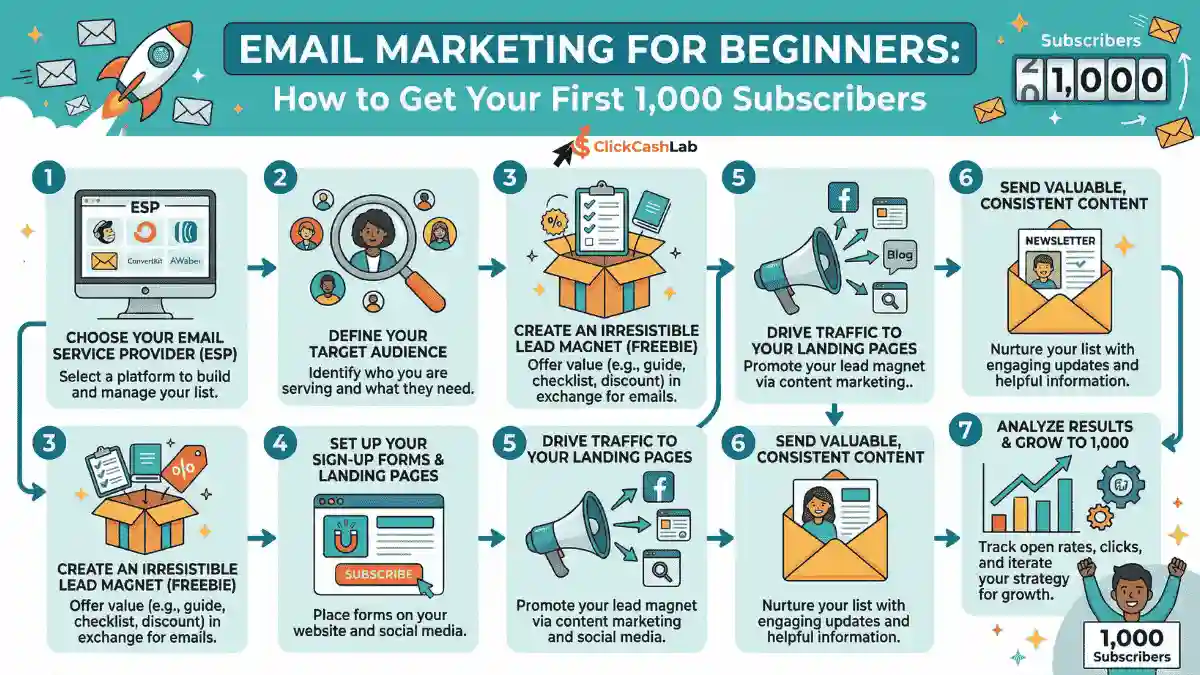
Reaching your first 1,000 subscribers with email marketing isn’t about chasing shortcuts or hacking the system—it’s about building something real, step by step. From understanding the fundamentals to choosing the right tools, creating irresistible lead magnets, and consistently driving traffic, every piece plays a role in your growth.
What makes email marketing so powerful isn’t just its ROI or automation capabilities—it’s the relationship you build with your audience. Every email you send is an opportunity to connect, to provide value, and to earn trust. And trust? That’s what turns subscribers into loyal followers and customers.
You don’t need to be perfect to get started. Your first email won’t be your best, and that’s okay. What matters is consistency, learning from your data, and continuously improving. The strategies you’ve learned here aren’t just theoretical—they’re practical, actionable, and proven to work.
If you stay committed, experiment with different approaches, and genuinely focus on helping your audience, hitting that 1,000-subscriber milestone won’t feel like a distant goal—it’ll feel inevitable.
FAQs
1. How long does it take to get 1,000 email subscribers?
It depends on your strategy and consistency. With strong organic efforts, it can take 3–6 months, while combining organic with paid strategies can significantly speed up the process.
2. Do I need a website to start email marketing?
Not necessarily. Many email platforms allow you to create landing pages. However, having a website can improve credibility and support long-term growth.
3. How often should I send emails to my list?
Consistency matters more than frequency. Once a week is a good starting point, but the key is to maintain a schedule your audience can rely on.
4. What is the best free email marketing tool for beginners?
MailerLite and ConvertKit are excellent choices due to their ease of use, automation features, and generous free plans.
5. Can I make money with a small email list?
Yes. Even a small, engaged list can generate revenue if you provide value and promote relevant offers effectively.
