 Skip to content
Introduction
Email Marketing vs Social Media & Which One Makes More Money? If you’re trying to build an online business in 2026, you’ve probably asked this question at least once: Should I focus on email marketing or social media? Both promise attention, growth, and—most importantly—money. But they don’t make money in the same way, and they definitely don’t make the same amount over time.
Social media feels exciting. You post content, get likes, maybe even go viral, and suddenly traffic spikes. Email marketing feels quieter. There are no flashy trends or viral moments—just messages landing directly in someone’s inbox. But behind that simplicity is something powerful: control and conversion.
The real difference between these two channels isn’t just where your audience hangs out—it’s how they behave. Social media users are scrolling for entertainment, inspiration, or distraction. Email subscribers are usually more intentional. They’ve already shown interest, which changes everything when it comes to making money.
That’s why businesses in 2026 are no longer asking which one is popular, but rather which one is profitable. Because reach doesn’t always equal revenue, and attention doesn’t always turn into sales.
In this guide, we’re going to break down email marketing vs social media in a clear, practical way. You’ll see how each channel actually generates income, where they outperform each other, and why the smartest strategy today isn’t choosing one—it’s understanding how both work together to build a system that consistently makes money.
Because at the end of the day, it’s not about where your audience is. It’s about how effectively you can turn that audience into revenue.
The Evolution of Digital Marketing in 2026
Digital marketing in 2026 looks very different from what it did just a few years ago. The landscape has become more competitive, more algorithm-driven, and—ironically—more unpredictable. If you’ve tried growing on social media recently, you’ve probably noticed how reach can fluctuate overnight. One post performs incredibly well, and the next barely gets seen. That’s not random—it’s the nature of platforms you don’t control.
At the same time, email marketing has quietly maintained its position as one of the most reliable revenue channels. While it may not feel as flashy as viral social content, it consistently delivers results. That’s because email operates on a fundamentally different principle—you own your list. No algorithm decides whether your message gets delivered (at least not in the same way as social feeds).
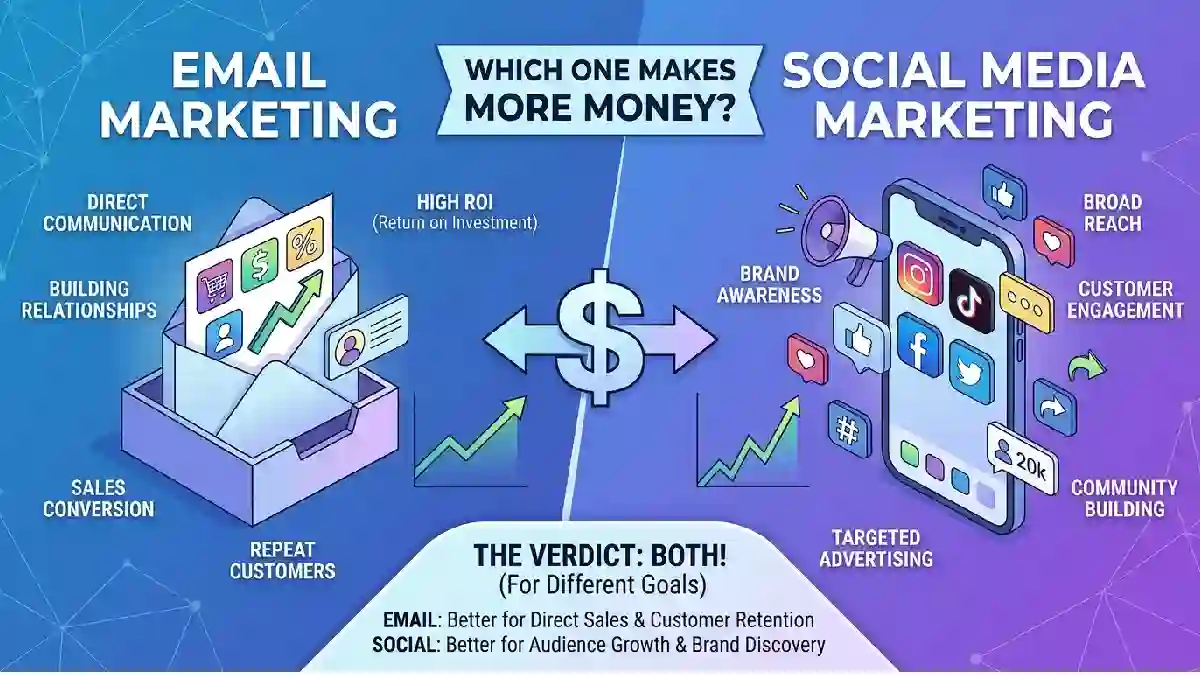
What’s changed in 2026 is how these two channels interact. It’s no longer about choosing one over the other—it’s about understanding how each contributes to revenue. Social media is often the discovery engine, while email is the conversion engine. But that doesn’t mean they’re equal when it comes to making money.
Another major shift is the increasing cost of attention. Paid ads on social platforms have become more expensive, organic reach has declined, and competition has intensified. This makes it harder for beginners to rely solely on social media for consistent income.
Meanwhile, email marketing tools have become more accessible and powerful, allowing even small businesses to create automated revenue systems. This shift has leveled the playing field, giving individuals and startups the ability to compete with larger brands. Email Marketing vs Social Media & Which One Makes More Money?
Understanding this evolution is key to answering the main question: which channel actually makes more money?
How Consumer Behavior Has Changed
Email Marketing vs Social Media & Which One Makes More Money?: Consumer behavior in 2026 is shaped by one major factor—information overload. People are constantly exposed to content, ads, and notifications. As a result, attention has become one of the most valuable—and scarce—resources.
On social media, users are in browsing mode. They’re scrolling, liking, and occasionally clicking, but they’re not always in a buying mindset. It’s more about entertainment and discovery than immediate action. That doesn’t mean social media can’t generate revenue—it absolutely can—but the intent is different.
Email, on the other hand, operates in a more focused environment. When someone opens their inbox, they’re often looking for something specific—updates, offers, or information. This creates a higher level of intent, which can translate into better conversion rates.
Another shift is trust. People are becoming more selective about who they engage with. Following someone on social media is easy—it takes one click. Subscribing to an email list, however, feels more intentional. It’s a small commitment, but a meaningful one.
There’s also the factor of privacy and data ownership. With increasing concerns around data usage, users are more cautious about where they spend their time and attention. Email feels more private and controlled compared to the public nature of social media.
These behavioral changes play a significant role in how each channel performs financially.
The Rise of Owned vs Rented Platforms
One of the most important concepts in modern marketing is the difference between owned and rented platforms. Social media falls into the rented category—you’re essentially borrowing space on someone else’s platform. Email marketing, on the other hand, is an owned channel.
This distinction has huge implications for revenue. On social media, your reach is controlled by algorithms. Even if you have thousands of followers, only a fraction may see your content. To reach more people, you often need to pay for ads.
With email, your reach is far more predictable. If you have 1,000 subscribers, a significant portion of them will at least see your email in their inbox. That level of control makes it easier to plan and forecast revenue.
Another advantage of owned platforms is stability. Social media platforms can change rules, reduce reach, or even shut down accounts. When that happens, your audience can disappear overnight. Email lists, however, remain yours regardless of platform changes.
This doesn’t mean social media isn’t valuable—it absolutely is. But when it comes to long-term revenue generation, owning your audience gives you a significant edge.
Understanding Email Marketing as a Revenue Channel

Email marketing is often underestimated because it doesn’t look as “exciting” as viral social content, but behind the scenes, it consistently drives some of the highest returns in digital marketing. The reason is simple: email is built around intent and permission. When someone joins your list, they are actively choosing to hear from you, which immediately places them closer to a buying mindset compared to most social media interactions.
At its core, email marketing works like a direct sales system that runs in the background. You’re not relying on algorithms to decide who sees your content. Instead, you’re speaking directly to people who have already shown interest in your product, service, or content. This creates a much shorter path from attention to conversion. Even a small email list can generate meaningful revenue if it is nurtured properly.
Another powerful aspect of email marketing is its ability to scale automation. Once you set up sequences—like welcome emails, product education series, or abandoned cart reminders—they continue working without constant manual effort. This means revenue can be generated even when you’re not actively sending campaigns. For businesses and creators alike, this “set it and optimize it” model is one of the biggest advantages of email.
Email also excels at personalization. Unlike social media, where everyone sees the same post, email allows segmentation based on behavior, interests, and purchase history. This means you can send highly targeted offers that feel relevant rather than random. And relevance directly impacts conversions.
When you combine intent, automation, and personalization, email marketing becomes less of a communication tool and more of a revenue engine. Email Marketing vs Social Media & Which One Makes More Money?
How Email Marketing Generates Income
Email marketing generates income through several direct and indirect pathways, all of which revolve around guiding subscribers toward action. The most straightforward method is direct product or service promotion. You send an email showcasing an offer, and a percentage of your audience clicks and purchases. This is especially effective when the audience already knows and trusts your brand.
Another major income stream comes from sales funnels. Instead of relying on a single email, marketers use structured sequences that gradually educate, build trust, and lead subscribers toward a purchase. For example, a free lead magnet might attract subscribers, followed by a series of educational emails, and finally a targeted offer. This step-by-step approach significantly increases conversion rates.
Email marketing is also widely used for affiliate marketing, where you earn commissions by recommending other products. Since email allows for detailed explanations and storytelling, it often converts better than social media posts, which are more fleeting.
For content creators, email can also drive ad revenue and traffic monetization. By sending subscribers to blogs, YouTube videos, or monetized platforms, each email becomes a traffic source that contributes indirectly to income.
Finally, email supports customer retention and upselling. Existing customers are often more likely to buy again, and email is one of the best tools for maintaining that relationship. Repeat purchases often generate more long-term revenue than acquiring new customers.
Key Advantages of Email Marketing for Monetization
Email Marketing vs Social Media & Which One Makes More Money? One of the biggest advantages of email marketing is its high return on investment (ROI). Because costs are relatively low and targeting is precise, even small campaigns can generate strong revenue. You don’t need massive reach—you need the right audience.
Another advantage is ownership and control. Your email list is an asset you fully control. Unlike social media followers, your ability to reach subscribers isn’t dependent on platform algorithms or advertising budgets. This stability makes revenue more predictable over time.
Email also offers high conversion rates compared to most other channels. Since subscribers have already opted in, they are warmer leads. This means they are more likely to take action when presented with an offer.
Additionally, email marketing provides long-term compounding value. Every new subscriber adds to your revenue potential. As your list grows, your income potential grows with it, often without needing proportional increases in effort.
Finally, email is highly scalable through automation. Once systems are in place, they can run continuously, generating consistent revenue with minimal ongoing input. This makes it especially powerful for solo entrepreneurs and small teams.
Understanding Social Media as a Revenue Channel
Social media operates in a completely different ecosystem compared to email. Instead of direct, permission-based communication, it functions as a discovery and engagement platform. Users are not primarily there to buy—they are there to scroll, interact, and consume content. This fundamental difference shapes how revenue is generated.
The biggest strength of social media is its ability to create massive reach quickly. A single post can potentially reach thousands or even millions of people if it performs well. This makes it incredibly powerful for brand awareness and top-of-funnel marketing. However, that reach is unpredictable and heavily influenced by algorithms.
Unlike email, social media does not guarantee visibility to your audience. Even if someone follows your account, they may never see your content unless it is boosted or highly engaging. This creates a layer of uncertainty when it comes to revenue generation.
Despite this, social media remains a crucial part of modern marketing because it excels at attention capture. It allows brands and creators to build personality, showcase value quickly, and connect with audiences in a more casual, visual way.
However, converting that attention into revenue often requires additional steps, such as directing users to a website, landing page, or email list. Without that bridge, monetization can be inconsistent.
How Social Media Drives Revenue
Social media generates revenue primarily through attention-to-action funnels. The process usually starts with content that attracts engagement—likes, comments, shares—and then moves users toward a conversion point.
One of the most common methods is direct selling through posts and ads. Businesses promote products or services directly on platforms like Instagram, TikTok, or Facebook. With strong visuals and compelling messaging, this can lead to immediate sales, especially for impulse-driven products.
Another major revenue driver is paid advertising. Social platforms offer advanced targeting options that allow businesses to reach highly specific audiences. When optimized correctly, ads can generate consistent returns, although costs have increased significantly in 2026.
Social media is also a powerful tool for influencer marketing and brand partnerships. Creators monetize their audience by promoting products from other brands, often earning based on reach, engagement, or conversions.
Additionally, social platforms drive revenue indirectly by building audiences for other channels. Many businesses use social media to grow email lists, drive website traffic, or promote digital products.
While the potential for revenue is high, it often requires continuous effort, content production, and algorithm alignment.
Strengths and Weaknesses of Social Platforms
The biggest strength of social media is its viral potential. Unlike email, where reach is limited to your list size, social content can spread far beyond your existing audience. This makes it ideal for rapid growth and brand exposure.
Another strength is engagement and interaction. Social platforms allow for real-time feedback, comments, and community building. This helps brands build personality and trust in a more informal way.
However, the weaknesses are equally important. The most significant drawback is algorithm dependency. Your visibility is controlled by platform rules that can change at any time, often without warning.
Another limitation is low conversion intent. Most users are not actively looking to buy while scrolling. This makes it harder to achieve consistent revenue without strong funnels or retargeting strategies.
Finally, there is the issue of lack of ownership. Your followers do not belong to you—they belong to the platform. If your account is restricted, shadowbanned, or lost, your entire audience can disappear.
These strengths and weaknesses are what define social media’s role in revenue generation: powerful for reach, but less reliable for consistent monetization compared to email.
Email Marketing vs Social Media: Direct Revenue Comparison
When you strip away all the theory and look purely at revenue performance, email marketing and social media operate very differently. One is built for conversion efficiency, while the other is built for attention volume. This difference is exactly why marketers in 2026 still debate which channel actually makes more money.
Email marketing tends to win when it comes to direct revenue per user. Since subscribers have already opted in, they are warmer leads. That means when you send an offer, a much higher percentage of people are in a mindset to act. Even small email lists can generate consistent income because the intent level is so strong.
Social media, on the other hand, excels at top-of-funnel reach. You can expose thousands of people to your content quickly, but only a small fraction will convert immediately. Most users are scrolling for entertainment, not actively looking to purchase. This creates a wider but shallower revenue funnel.
The key difference comes down to intent vs exposure. Email captures intent that already exists. Social media creates awareness that may or may not turn into intent later. That’s why email often produces more predictable revenue, while social media produces more variable spikes.
Another important factor is consistency. Email campaigns deliver relatively stable performance metrics. Social media performance can fluctuate dramatically based on algorithm changes, trends, or even posting time. This makes revenue forecasting much easier with email marketing.
In short, email is about depth of monetization, while social media is about breadth of exposure.
ROI, Conversion Rates, and Engagement Metrics
If we look at ROI (Return on Investment), email marketing consistently outperforms social media in most industries. Studies over the years—and current 2026 benchmarks—continue to show email delivering an average ROI of $30–$40 for every $1 spent, depending on execution and niche. This is largely because email campaigns are low-cost and highly targeted.
Social media ROI, by contrast, varies much more widely. Organic content may generate strong returns without direct cost, but it requires significant time investment. Paid social ads can generate revenue, but rising advertising costs and competition often reduce margins.
Conversion rates also highlight a major difference. Email conversion rates typically range from 2% to 5% or higher, especially for warm audiences. Social media conversion rates are often lower at the direct post level, usually around 0.5% to 2%, depending on the platform and funnel setup.
Engagement is where social media appears to dominate at first glance. Likes, comments, shares, and views are significantly higher than email interactions. However, engagement does not always equal revenue. Email engagement may look smaller on paper, but it is often more directly tied to purchasing behavior.
So while social media wins in visibility metrics, email wins in profit-driven metrics.
Cost vs Return: Which Is More Profitable?
When evaluating profitability, it’s important to consider both monetary and non-monetary costs. Email marketing typically has a low operational cost. Even paid email tools are relatively affordable, and once systems like automation and funnels are set up, they require minimal ongoing expense. The biggest “cost” is content creation and strategy.
Social media, however, often requires continuous investment—either in time or money. Creating consistent content for multiple platforms can be demanding. If you choose to scale through ads, costs can rise quickly, especially in competitive niches.
From a return perspective, email marketing tends to deliver higher profit margins per subscriber. Once someone is on your list, you can market to them repeatedly without additional acquisition costs. This compounding effect increases long-term profitability.
Social media can still be highly profitable, especially for brands that go viral or leverage influencer ecosystems. However, maintaining that profitability often requires constant content output or ad spend.
In simple terms, email marketing behaves more like an asset that grows in value over time, while social media behaves more like a traffic engine that needs constant fuel.
Real-World Case Studies and Examples
To understand the real difference between email marketing and social media, it helps to look at how each performs in practical scenarios. Many businesses today don’t rely on just one channel—they use both—but the revenue behavior of each is still very distinct.
For example, consider a small online course creator. On social media, they might post educational content that reaches thousands of viewers. A viral video could bring a sudden spike in traffic and even some sales. However, once the post loses visibility, the traffic drops almost immediately. Revenue becomes inconsistent and heavily dependent on algorithm performance.
Now compare that with email marketing. The same creator builds a list of 5,000 subscribers. Every time they launch a course or promotion, they can directly reach those subscribers. Even with modest open rates, a predictable percentage of the list will convert. This creates repeatable, forecastable revenue cycles.
Another example is eCommerce brands. Social media platforms like Instagram and TikTok are excellent for product discovery. A viral post can lead to a surge in sales overnight. But email marketing is what drives repeat purchases, abandoned cart recovery, and long-term customer value. Many successful stores report that a large percentage of total revenue comes from email sequences rather than social traffic.
Influencers also provide a clear comparison. Social media is their main stage for audience building, but monetization often becomes unstable without email support. Those who transition their followers into email subscribers tend to stabilize their income because they are no longer fully dependent on platform algorithms.
These real-world examples highlight a consistent pattern: social media creates spikes, while email creates stability.
When to Choose Email Marketing Over Social Media
Email marketing becomes the stronger choice when your primary goal is consistent and predictable revenue. If you are running a business that relies on repeat sales, product launches, or long-term customer relationships, email provides the structure needed to support that.
It is especially effective when you already have an audience or traffic source. If people are visiting your website, blog, or landing pages, capturing them into an email list allows you to monetize that traffic multiple times instead of losing it after one visit.
Email also becomes more important when you want to reduce dependence on algorithms. If your business cannot afford sudden drops in visibility or engagement, owning your audience through email provides stability.
Another situation where email wins is high-ticket sales or complex products. When customers need time to make decisions, email sequences can nurture them gradually, something social media struggles to do effectively.
When Social Media Outperforms Email Marketing
Despite email’s strengths, social media still has clear advantages in certain situations. It performs best when your goal is rapid audience growth and brand awareness.
If you are launching a new brand or product, social media can expose you to large audiences quickly. Viral content, trends, and short-form videos can generate massive visibility in a short period of time—something email simply cannot match.
Social media also excels in visual storytelling and entertainment-based niches. Fashion, travel, fitness, and lifestyle brands often thrive because these platforms are highly visual and engagement-driven.
Additionally, if you rely heavily on influencer marketing or community-driven growth, social media becomes essential. It enables real-time interaction, trend participation, and audience engagement in ways email cannot replicate.
However, even in these cases, social media works best as a top-of-funnel engine, not a standalone revenue system.
The Best Strategy: Combining Both Channels
The strongest marketing systems in 2026 don’t choose between email and social media—they combine them strategically. Each channel plays a different role in the customer journey.
Social media acts as the attention generator, attracting new audiences and driving discovery. Email acts as the conversion and retention engine, turning that attention into revenue and long-term value.
Building a Funnel That Converts
A high-performing funnel often starts with social content that leads users to a landing page or free offer. Once users subscribe, email sequences take over. These sequences educate, build trust, and guide users toward purchasing decisions.
This combination solves the biggest weakness of social media—lack of ownership—and the biggest weakness of email—limited discovery.
Turning Followers into Subscribers
One of the most effective strategies is converting social media followers into email subscribers. Instead of relying on algorithm visibility, you invite followers to join your list in exchange for value such as guides, discounts, or exclusive content.
Once they are on your email list, you gain direct access to them regardless of social platform changes. This shift is what transforms unstable social growth into predictable revenue.
Common Mistakes That Reduce Revenue
One of the biggest mistakes marketers make is relying too heavily on social media without building an email list. This creates vulnerability because all traffic remains dependent on external platforms.
Another common issue is treating email as an afterthought. Some businesses collect emails but never nurture them properly, missing out on significant revenue opportunities.
On social media, chasing viral content without a conversion strategy is another frequent mistake. High views mean little if they don’t lead to meaningful actions.
Finally, failing to integrate both channels is a missed opportunity. When email and social media operate in isolation, the overall revenue potential is significantly reduced.
Conclusion
Email marketing and social media are not competitors in the traditional sense—they are different systems designed for different outcomes. Social media dominates when it comes to reach, visibility, and fast audience growth. Email marketing dominates when it comes to conversions, stability, and long-term revenue.
In 2026, the businesses and creators making the most money are not choosing one over the other. They are using social media to attract attention and email marketing to convert that attention into predictable income.
If social media is the spark, email is the engine that keeps everything running.
FAQs
1. Is email marketing more profitable than social media?
In most cases, yes. Email marketing typically delivers higher ROI and more consistent conversions.
2. Can social media replace email marketing?
No. Social media is great for reach, but email is more effective for direct revenue and long-term customer relationships.
3. Why does email convert better than social media?
Because email audiences are opt-in and already interested, meaning they have higher purchase intent.
4. Should beginners focus on email or social media first?
Ideally both, but starting with social media for traffic and building an email list early is the most effective approach.
5. What is the best strategy to maximize revenue?
Use social media for awareness and funnel audiences into email marketing for conversions and retention.
Proven Subject Line Formulas + How to Write Emails That Actually Get Opened
(Tested & Ranked) Top Free Email Marketing Tools for Beginners
How-to-Build an Email-List In 2026 From Scratch Without Paid Ads
